Blog #9 Muslim immigration to Europe and the hidden journey to the new land

By: Lana Henderson

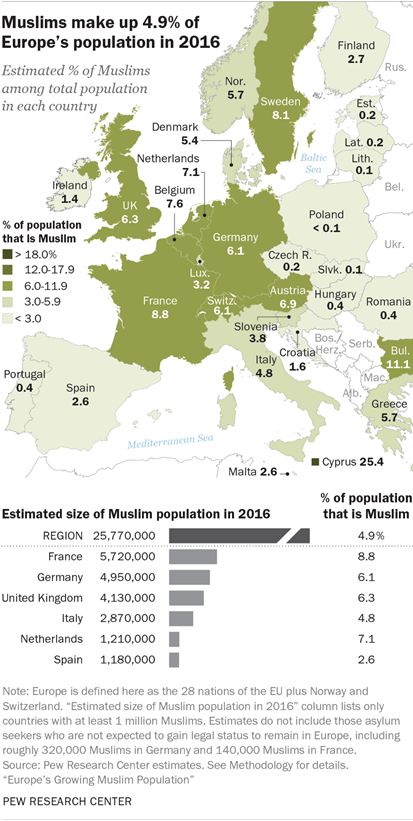
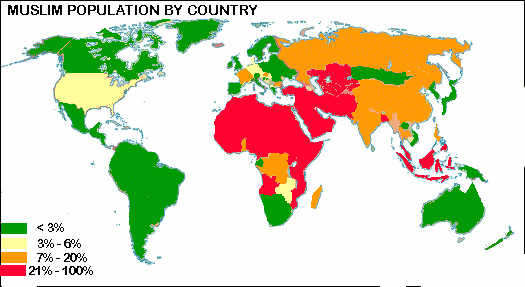
This image shows the amount population in the countries.

Zemni and Parker discuss how Europe was not the welcoming place it was portrayed to be after world war II. There was a lot of action put in place to try to unify the country itself that often-meant measures that where generally not very inclusive to immigrant populations. Due to historically context and relationships Muslim immigrants are among a group of immigrants who face discrimination and do not feel able to assimilate into their new countries as immigrants. This is especially due to colonization roots and ties to specifically northern African Muslim populations and the belief this created about being unable to integrate into the elite and civilized European societies. Due to this they were always seen as another even as a born citizen the cultural markings of Islam kept people separate from those in their country. Due to a multiculturalist vision that only services specific interests there is a lot of space for European immigrants to interact as in a different European country as immigrants, but Muslim immigrants do not face this same inclusion when the move into these areas. Part of this could be due to the Christian ties in European history though many European countries today are not influenced by religion the same way they were in the past.
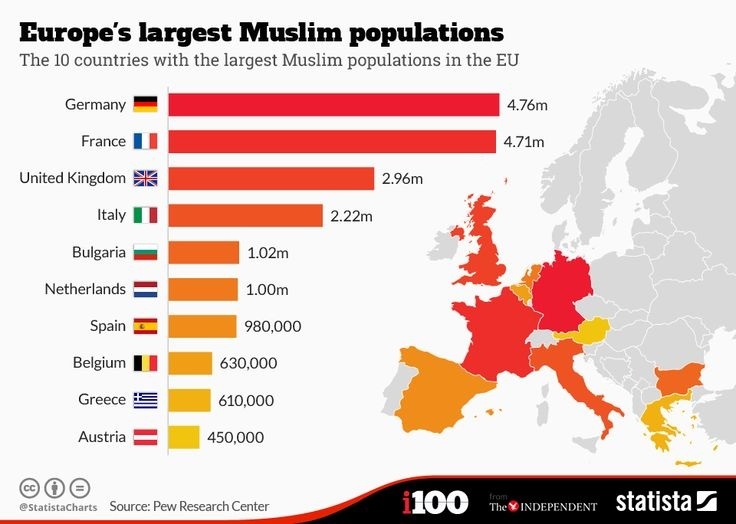
This image shows how the Muslim population is distributed in Europe.

While watching the film my escape it is clear that this is a very dangerous journey, and no one truly understands what they are really getting themselves into but because of the problems and war they face in their own country of Syria there is no doubt that they have to get out. The sprawl outwards took Syrian immigrants on many different paths out of the country to their surrounding neighbors. The journey through Germany was a point that showed that there was established refugee points that were not disturbed by police and often an area where people could find help to get them established or to their next destination. Though one big part of the process that made the situation extra scary for immigrating was the smugglers who would often pretend to be nice when they first start making the arrangements for paying for their trip to their new life and seem to only want to help the people.
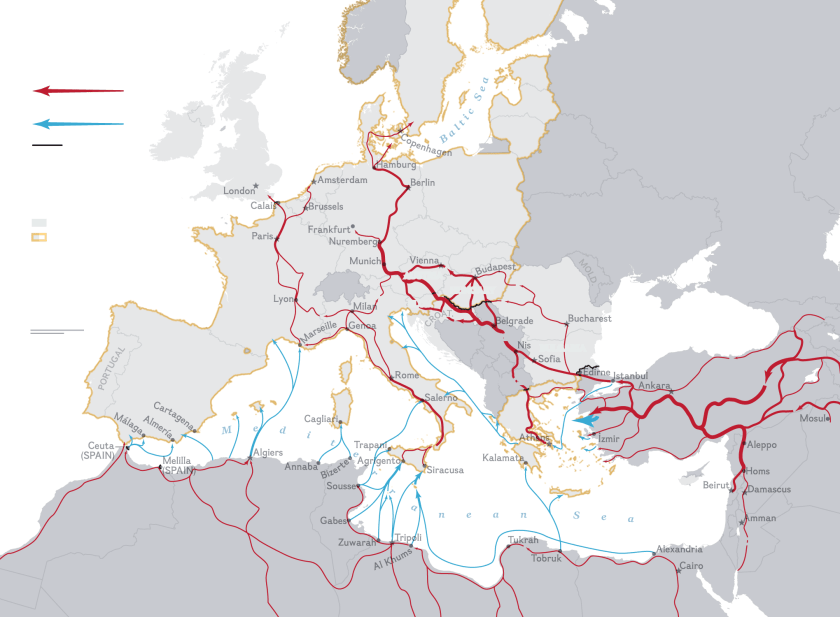
This image shows routes from migration routes of refugees to Europe.

Though soon many come to realize that the smugglers are mean people who do not care about their lives only the money that they provide, and this is often apparent in the modes of transportation that they take to get across. Often the routes where on very dangerous roads in overpacked cars or by foot on mountain routes that were very dangerous and often lead to groups having to split up from their loved ones. People also feared the smugglers because they were often armed with weapons and it was clear that opposition to the way they were running their operation. Often people died on the trip because of the unsafe conditions and the smugglers wouldn’t care at all or repay the family. Another fear especially women faced on these trips was the fear that smugglers would exchange them with traffickers, and they would be taken away and held for ransom and many times their family had no money especially after paying the smugglers. This led to women becoming sex trafficked and many times their families never see them again. To be able to have less fear of this many woman will try to assimilate to look like women in the cultures where they are going to.
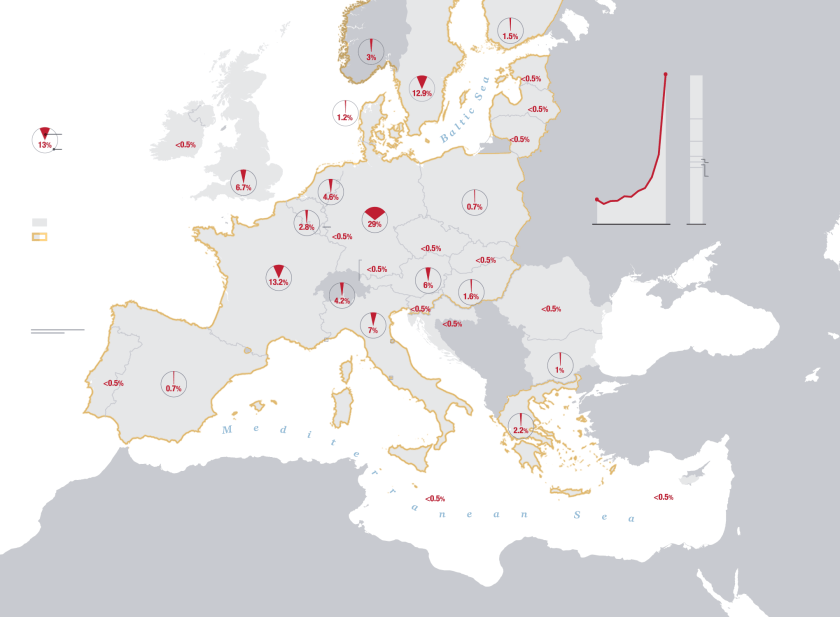
This image shows routes and percentages from migration routes of refugees to Europe.

Resources

Desjardins, Jeff. “Does Europe Take in Enough Migrants? [Chart].” Visual Capitalist, 4 Sept. 2015, https://www.visualcapitalist.com/does-europe-take-in-enough-migrants-chart/. Hammond, Robin. “How the Latest Great Migration Is Reshaping Europe.” Magazine, 15 Sept. 2016, https://www.nationalgeographic.com/magazine/2016/10/europe-immigration-muslim-refugees-portraits/. Shah, Zia H. “Muslims in Europe: Promoting Integration and Countering Extremism.” The Muslim Times, 20 Sept. 2011, https://themuslimtimes.info/2011/09/20/muslims-in-europe-promoting-integration-and-countering-extremism/The Trek: A New Life in Germany | Germany | Al Jazeerahttps://www.aljazeera.com/programmes/witness/2016/09/trek-life-germany-refugees-160912111625923.html. Accessed 2 Apr. 2019. Von der anderen Seite beleuchtet. My Escape ⁄ Meine Flucht Part 1  with English Subtitles!!YouTubehttps://www.youtube.com/watch?v=qtMlN3nqL4c&feature=youtu.be. Accessed 2 Apr. 2019. Which Countries in Europe Are Muslim Majority? – Quorahttps://www.quora.com/Which-countries-in-Europe-are-Muslim-majority. Accessed 2 Apr. 2019.
Blog Post #8 Headscarfs and the misunderstood plight of a Muslim Woman

By: Lana Henderson

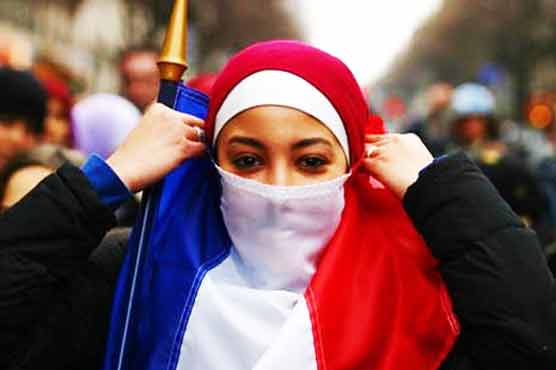
This image is from a the first muslim country win of a world cup. This image is from Reddit

The history of Muslims in France is very similar to most immigration stories for those new to the western world. When Muslim immigrants began to enter France there was a movement to try and assimilate them into their new culture. Scott discusses that many Muslim immigrants came from the north African regions and were seen as un civilized based on French standards. When looking at France’s colonization within Africa it is not surprising the way that African immigrants were treated once they came to France as many of the cultural colonization stereotypes and treatments carried into immigration. Women in particular had even more issues when it came to being Muslim in their new French civilizations. During colonization Northern African woman faced a lot of sexualization and exploitation of their bodies and positions in society reduced to sexual work as a means of their value. These are not the only ideas that also made their way over to France and perpetuated racist and sexist stereotypes about the Muslim immigrants. Due to the recent terrorist attacks in the past 10 years and the way this has shaped the rhetoric of Muslims in the media. Though there are monuments in France that tie to the Muslim history in France such as in the edge of the Latin Quarter with an ancient mosque that is historically said to be an area that had many different kinds of people walking around and preforming.

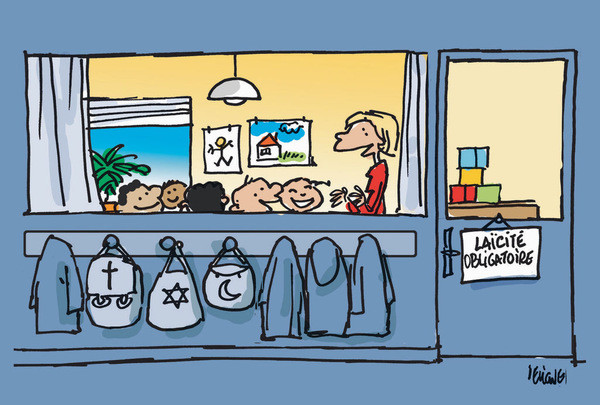
This image is a political cartoon addressing Laicite. This image is from LaCroix

Laïcité is unique in some ways from the way secularism is discussed in certain other countries but is unique in its practice. China is one country that comes to mind when thinking of secularism and the way they have integrated that even into their government. China is an extreme version of a government that has turned secularism into a religion in its own way by making the government the “gods” or entities to be looked up to and praised for all they have done to make the lives of the citizens better.  The French focus more on individualism though the same idea of being united through a French nationality is similar to the patriotism seen in secular countries such as china and a belief that what matter is having a strong tie to your national identity. Scott explains that the headscarf ban in French was tied to Laïcité due to the secular movement tie with protecting French citizens from being rules under a religion. The headscarf worm by many women who practice Islam is a clear way to mark a group outside of what is considered the cultural normal in Western Culture. In the French societal tradition of Laïcité, is the idea of individualism and having your own style belief and individualism that ties people more in unification under their French identity than to any specific group they are tied to.

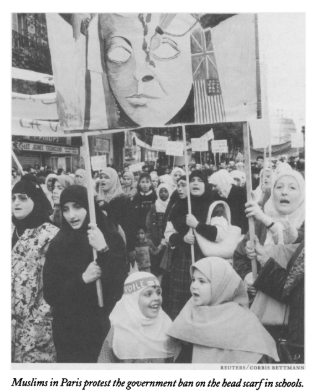
This image is from The Muslims of France

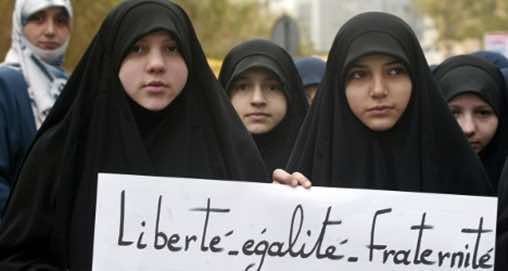
Laïcité is also meant to be a way in French eyes to promote equality through everyone being French no matter what race, religion or anything else they follow. Though the headscarf worn by many women who practice Islam to many in France goes against the traditions of Laïcité that they grew up in and in many cases distinguishes the group from other French citizens therefore the headscarves have been targeted in legislature that requires people not to wear them. Many women and organization in response to these laws began forming protests against the laws that caused this discrimination.

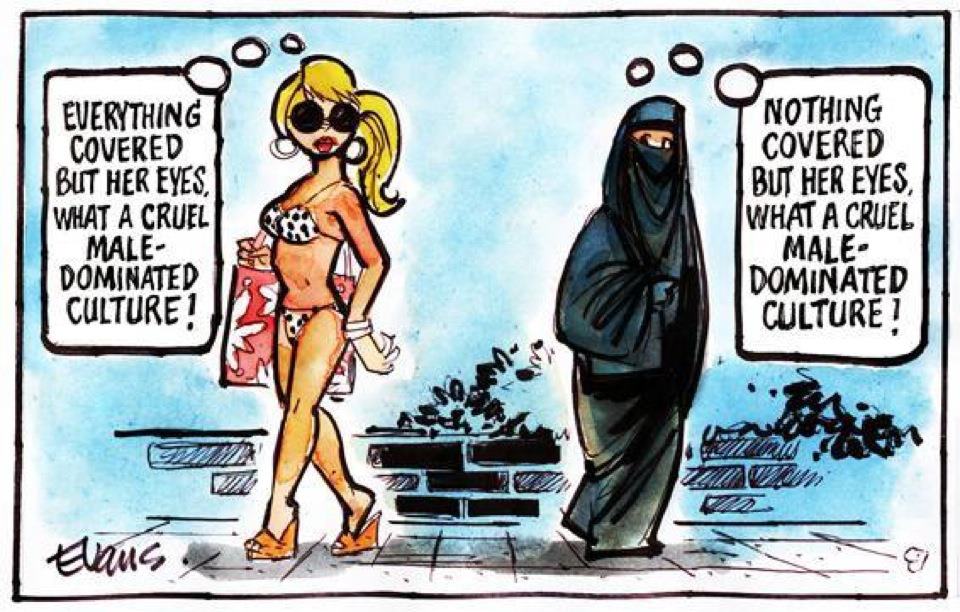
This image is a political cartoon from Patheos

Due to the different way’s sexuality is explored in Western Culture and the way that other cultures are left out of general education has certainly led to a lack of understanding with differences in other cultures. I personally side with people who choose to rise up against unjust laws based in the French principle Laïcité. I think that at its core Laïcité is about celebrating being French and practicing your faith doesn’t take away from your national identity. This goes back to the discussions we had last week about Islam in a political context versus a religious context. One of the major notable differences is that within religion is really controlled by the individual who follows the faith and in the political dimension there is social and even sometimes governmental consequences of not following the word of the Quran. I think people misinterpret a practicing of faith with oppression, in many cases in the Western world women who wear the Quran have made this choice for themselves because unlike laws that may permit them not to wear them there really is no law permitting them to wear them. I’m not saying this is the case for all Muslim women in the western world but really most times it’s a lack of understanding how this act helps women to feel connected to their faith. Many times, women even began wearing the headscarf because their rights to wear it was taken from them. There is no doubt women around the world who experience oppression through wearing the headscarf but is not the reason many followers of the religion see the interpretation of from within the Quran. But a true act of oppression is arresting women at a beach for wearing a burkini, no matter its religious ties a woman should be able to wear whatever she wants to go out and enjoy day activities.  Followers of Islam that I have talked to in the past see the headscarf as a protection for women so that they are valued for more than their looks. Many Muslim women see western women as the ones who are actually oppressed due to the sexual way they are discussed in media and shown to be sexual objects most times when others observe western culture. One thing to keep in mind is choice, many of us grew up with very different values or principles therefore what may be restrictive in one household can be seen as extremely liberating in another, unless there is a direct call to action from those impacted I think one thing the western world could benefit from is not interfering with other cultures practices unless asked.

Resources

La-Croix.com. “Laïcité, la loi « Baby-Loup » demeure bien floue.” La Croix, 13 May 2015, https://www.la-croix.com/Actualite/France/Laicite-la-loi-Baby-Loup-demeure-bien-floue-2015-05-13-1311844.

Piser, Karina. “A New Plan to Create an ‘Islam of France.’” The Atlantic, 29 Mar. 2018,https://www.theatlantic.com/international/archive/2018/03/islam-france-macron/556604/.

“R/The_Donald – Muslim Country Wins World Cup for The First Time! France Wins Final Match (With a Little Help From the Referee).” Reddithttps://www.reddit.com/r/The_Donald/comments/8z332n/muslim_country_wins_world_cup_for_the_first_time/. Accessed 18 Mar. 2019.

UC Berkeley Events. Conversations with History – Joan Wallach ScottYouTube,https://www.youtube.com/watch?v=MrknwNl818Y. Accessed 18 Mar. 2019.

Viorst, Milton. “The Muslims of France.” Foreign Affairs, vol. 75, no. 5, 1996, pp. 78–96. JSTOR, JSTOR, doi:10.2307/20047745.

“Why France Is in Uproar over the Burkini – and Why It Matters.” The Independent, 24 Aug. 2016, http://www.independent.co.uk/news/world/europe/burkini-ban-why-is-france-arresting-muslim-women-for-wearing-full-body-swimwear-and-why-are-people-a7207971.html.

French Muslims and French Islam

Amber Jones Blog Post #8 3/19/2019

When we look at the Muslim population in France, we have to realize that it is one of the main focal points for many reasons.  Why is France important though?  We see that the highest Muslim population resides in this country.  It is noted that the locale of France is a huge reason, as well as France being one of the countries that colonized many of what is now seen as Muslim countries.

Even in culture, it is noted that the French language is adopted among many Muslims, ad due to the colonization by France earlier in these Muslim countries, the French language had already spread.  Because of this, France is easily accustomed to. 

Looking at the idea of Muslims and the Islamic community lagging behind can be attributed to the fact that many Muslims and Islamists are seen as outside the cultural norm.  Many refugees are looked down upon, as usually they have nothing, no money or possessions.  Across many cultures, the poor and minority groups are usually pushed outside the mainstream culture.  Even here in America, we look at the Hispanic population, whom we are often out to ostracize and put down, just because of their heritage and background.  Sometimes they are viewed as even a threat.  Our culture accuses them of stealing our jobs and so on, when all they want is just a chance at a better life.  We can relate this to the Muslim culture in France, as the French people see this culture as outside the norm and pushes back on the inclusion of these cultures into their society.  Because of this push back, many Muslim people can find themselves lagging socially and financially behind.

http://inpra.in/2016/10/12/burqa-ban-values-under-the-veil-of-democracy/

Religiously, France is much like America with their idea of Laicite.  This is equated to a separation of church and state, for the best definition.  France is more successful at this than the US, but it is important to realize what this is to speak about how this relates to this Muslim refugee population.  France’s ideals of separation are opposite of that in the Islamic world.  In the Muslim world, Islam rules the lives of those who practice the religion.  Religion dictates everything in the Islamic faith, which has clashed with the secularism in France notably.  Through France trying initiate burka bans and promoting a separation of religion and culture, Islam has suffered, and we see the emergence of radical extremists, who unfortunately make headlines for bombings, and threats of destroying western culture for being “infidels”.  This terror has made people of all western culture, not just France, afraid of the burka / headscarf.  While it may be an unfair assumption, we associate this article of clothing with a religion that has committed heinous crimes, and we have begun to fear it.

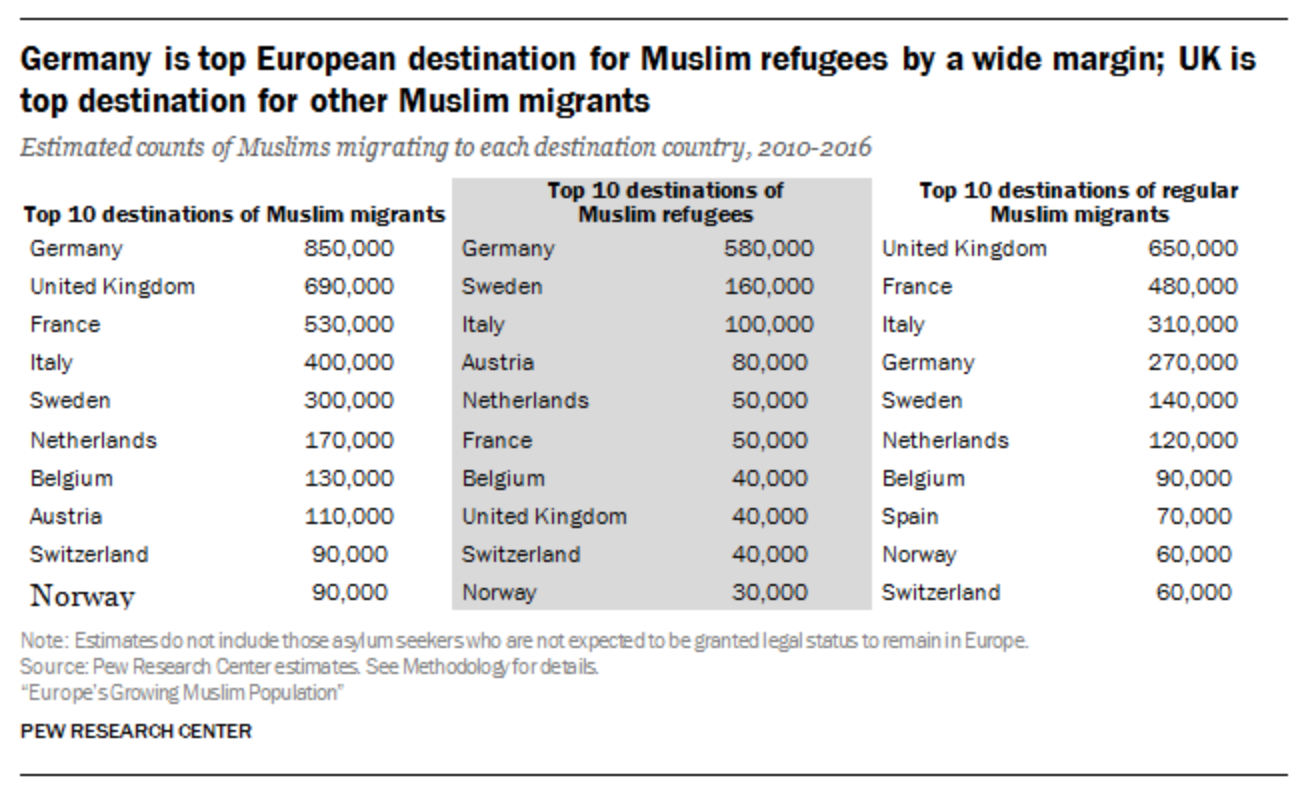
Blog Post 8 –France’s relationship with the Muslim community

By – Jacob Feist

Part 1: Background, History & Economy

Background: Post 7 outlined the current relationship between the Muslim community and the native community in Europe. This dynamic is highlighted and amplified in France due to population size and current events. France has the largest Muslim population of all European countries and many Muslims have found France to be their home. These members of the French community have embraced the local culture and Identify as French Muslims. Yet, certain dimensions of French culture have created conflict. In the book, “Islam, Europe’s Second Religion” Hunter breaks down these cultural aspects into three categories.

  1. Laicité secularism discourages government from operating within religious affairs or capacities
  2. Negative Muslim generalizations and reputation stemming from France’s relationship with Algeria
  3. The Muslim community not assimilating creates friction with the French community
http://www.pewforum.org/2017/11/29/europes-growing-muslim-population/

History: However, to further understand the current situation, one must understand the history of the situation. The first wave of French immigration occurred in 1914 as a result of the WWI and the rise of industrialization in France. This trend continued, as labor and industry developed, as did the need for workers and immigrants. Many of these vacant jobs were filled by Algerians who fought on the side of the French during the War for Independence. In 1970, this immigration model was drastically changed. The job market decline and immigrants stopped coming to France in search of work, rather they were attempting to reunite with their family members. Consequentially, the goal of immigration shifted from temporary work to permanent relocation.

Economy: Naturally, friction within history and government has shaped the modern economic landscape for French Muslims. Unemployment for the Muslim community is almost twice the French national average. This problem is reinforced by a lack of full-employment, as Muslim discrimination has caused educated Muslims to receive less fortuitous job opportunities. As a result, Muslims have been trying to find alternative methods to entering the job market. The current models include the 1998 “Positive Discrimination” law to receive greater opportunity and finding progressive globalized businesses.

Part 2: Laicité in Modern Context

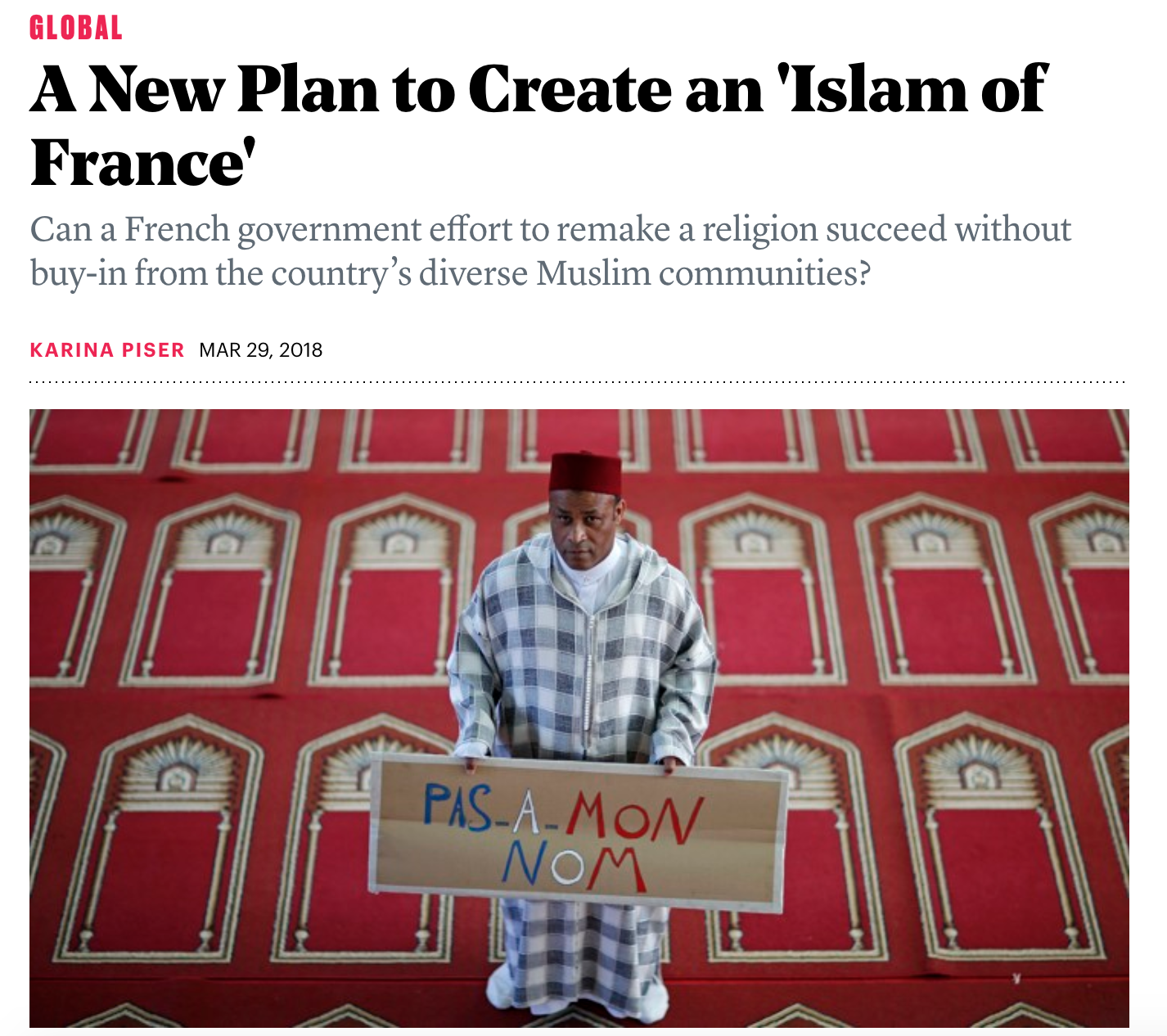
Briefly mentioned above is the concept of Laicité, which can be best paralleled to the separation of church and state in the U.S. This law from 1905 ordains that French government should not interact or interfere with religion. The critical difference in the U.S. version and French version is that the French takes the rule to a far greater extreme. Laicité dictates that no official statistics about religion can be surveyed by the government. Hence, there are no official records regarding Muslim residents in France. Yet, accurate census data is not the only, or most critical, aspect of Laicité being challenged by Muslim presence in France. Laicité has been challenged by the use of hijab in public spaces, Emmanuel Macrons recent comments about “Islam of France”, and civil and government debates.

This brings in the argument of Laicité’s place within the modern world. I understand the division between religion and government. Additionally, I think most functioning democracies require this separation. That being said, dialogues must occur within government to address certain realities. As Hunter explains at the beginning of chapter 1, the religion of Islam is a reality in France. Thus, the government must respond accordingly to create systems of integration.

Part 3: Hijab painted as a threat to the west

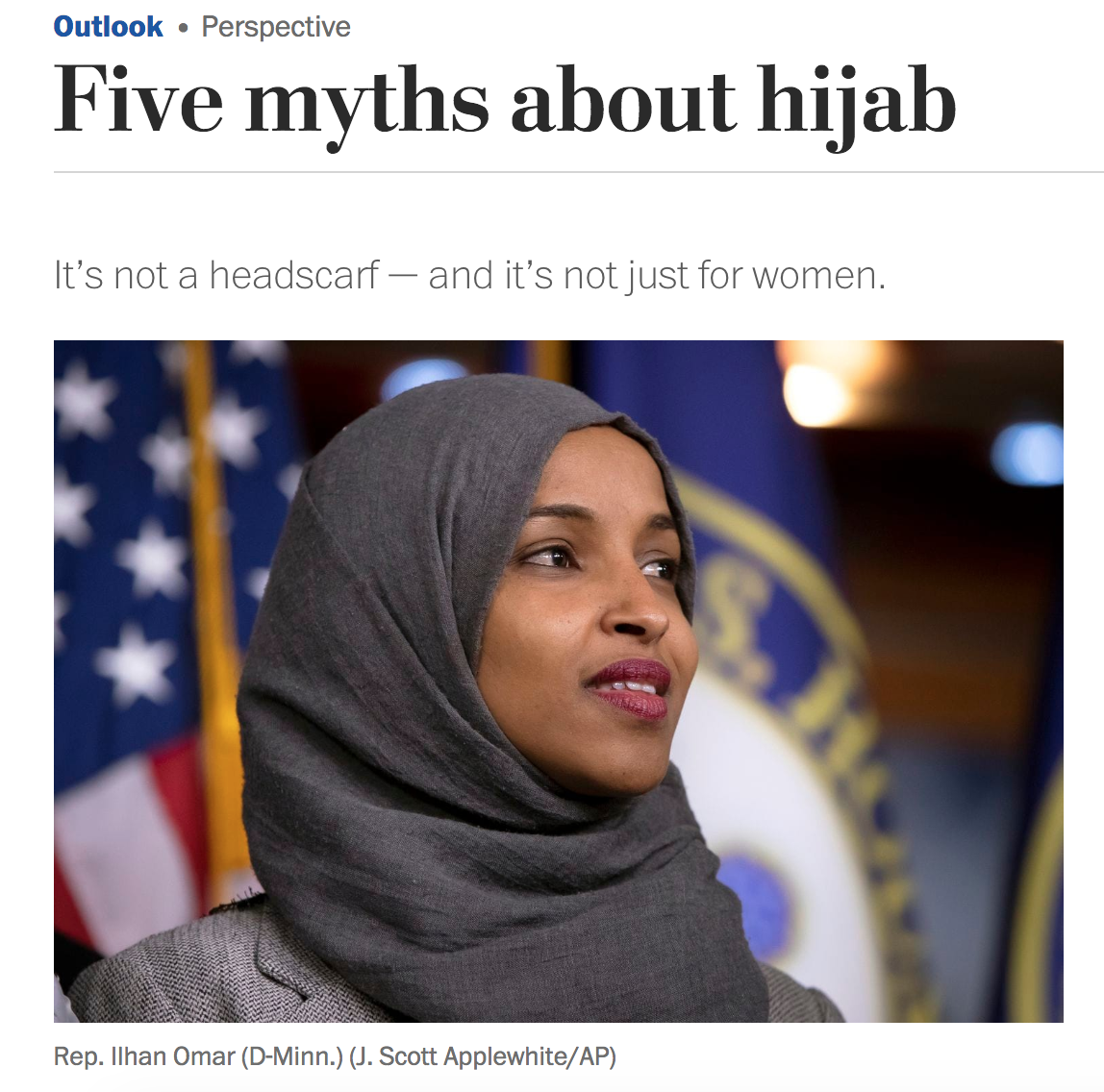
One of the most difficult aspects of Muslim integration and acceptance in Western society is the hijab. This symbol of privacy and modesty has been radicalized by the western world as a symbol of tension between Muslims and non-Muslims. Moreover, this is not a new phenomenon. This demonization and negative imagery has been created over the course of several decades.

https://www.washingtonpost.com/outlook/five-myths/five-myths-about-hijab/2019/03/15/d1f1ea52-45f6-11e9-8aab-95b8d80a1e4f_story.html?utm_term=.cb685609936e

In France, it was publicly criticized as being a symbol of jihad extremists, which is objectively false. This extends to America, with recent headlines criticizing political leaders for wearing a hijab. Certain American news outlets and political leaders have questioned whether people wearing the headscarf can truly be loyal to America. The quote that resonates with me is, “People fear what they do not understand.” A lack of dialogue has allowed anti-Muslimism parties to paint the hijab as a threat to the west. Thus, creating the notion that somehow religious expression is a threat to one’s own ideals.

Sources:

“Chapter 1 – Islam in France.” Islam, Europe’s Second Religion: the New Social, Cultural, and Political Landscape, by Shireen T. Hunter, Praeger, 2002.

https://www.cnn.com/2019/03/16/media/jeanine-pirro-fox-news/index.html

http://www.pewforum.org/2017/11/29/europes-growing-muslim-population/

https://www.theatlantic.com/international/archive/2018/03/islam-france-macron/556604/

Post 7 – Tension in Europe

By Jacob Feist

Part 1: The Myths

In Justin Vaisse’s paper, “Muslims in Europe: A short introduction”, he outlines four myths pertaining to Muslims in Europe and the negative ramifications of each misconception.

Myth #1: Being Muslim completely encompasses one’s full personality and ideologies. This myth creates the stereotype that all Muslim immigrants have the same priorities and beliefs.

Myth #2: Muslims in Europe are all foreign entities or arrived from the Middle East. This myth stripes many Muslims native to the region of their European identity.

Myth #3: Muslims in Europe are a “cohesive and bitter group” (https://www.foreignaffairs.com/articles/europe/2005-07-01/europes-angry-muslims). Vaisse explains that there are geographic, social, and political dimensions to Muslims.

Myth #4: The Muslim community is overtaking the European population. This myth creates the idea that the Muslim community is somehow separate from the native community. Additionally, it is archaic as the birthrates between immigrant and non-immigrant communities are moving towards equal.

These myths create a toxic and contentious dynamic between Europeans and European Muslims. Ramadan explains that the mindset should be one that understands that Muslim is a fully integrated part of European society. Moreover, the religion is a way of life and political and social discussion cannot be fully realized until people are willing to educate themselves on the religious dimension.  

Part 2: The distinction between politics and religion

In Hunter’s “Europe’s Second Religion”, the author outlines the importance between political and religious dimensions for Muslims. She explains that these dimensions are not the same, but that does not necessarily mean they create conflict. The religious dimension applies to the laws ordained within the Quran and the activities related to worship. However, the political dimensions relates to social affairs. The only universal connection is that the social affairs cannot interfere with the religious dimension. Thus, Muslims can have varying political, social, and economical beliefs. Moreover, Muslims have a “principle of original permission” stating that they may take what is good from other cultures. This indicates that over time Muslims will adopt certain positive aspects of European culture. Hence, the two communities must create dialogue and education to encourage the adoption of these positive aspects and the integration of Muslims into society.

Part 3: Education and Social Rifts

As mentioned in Part 1, discussions between native Europeans and Muslim Europeans have been hindered by a lack of understanding. Additionally, these dynamics have been strained by a series of perpetuated myths. Thus, rifts have been developed in the education and social systems within Europe. Ramadan explains that the rift is created because political and economic integration is expected without discussing the underlying cultural and religious differences. Currently, education is superficial without enough about understanding the true identity and core issues for Muslims within Europe.

Moreover, a social rift is being created because of a lack of understanding on Shari’a law. Often, Europeans view this system as method of the of asserting Muslim law in Europe. However, this could not be further from the truth. The author explains that Shari’a law is far more inclusive than just a system of law and penalties. In actuality, Shari’a law is a system dedicated to finding religion and faith in any location of community. Hence, this should be used as a method of inclusion and adaptation rather than tension.

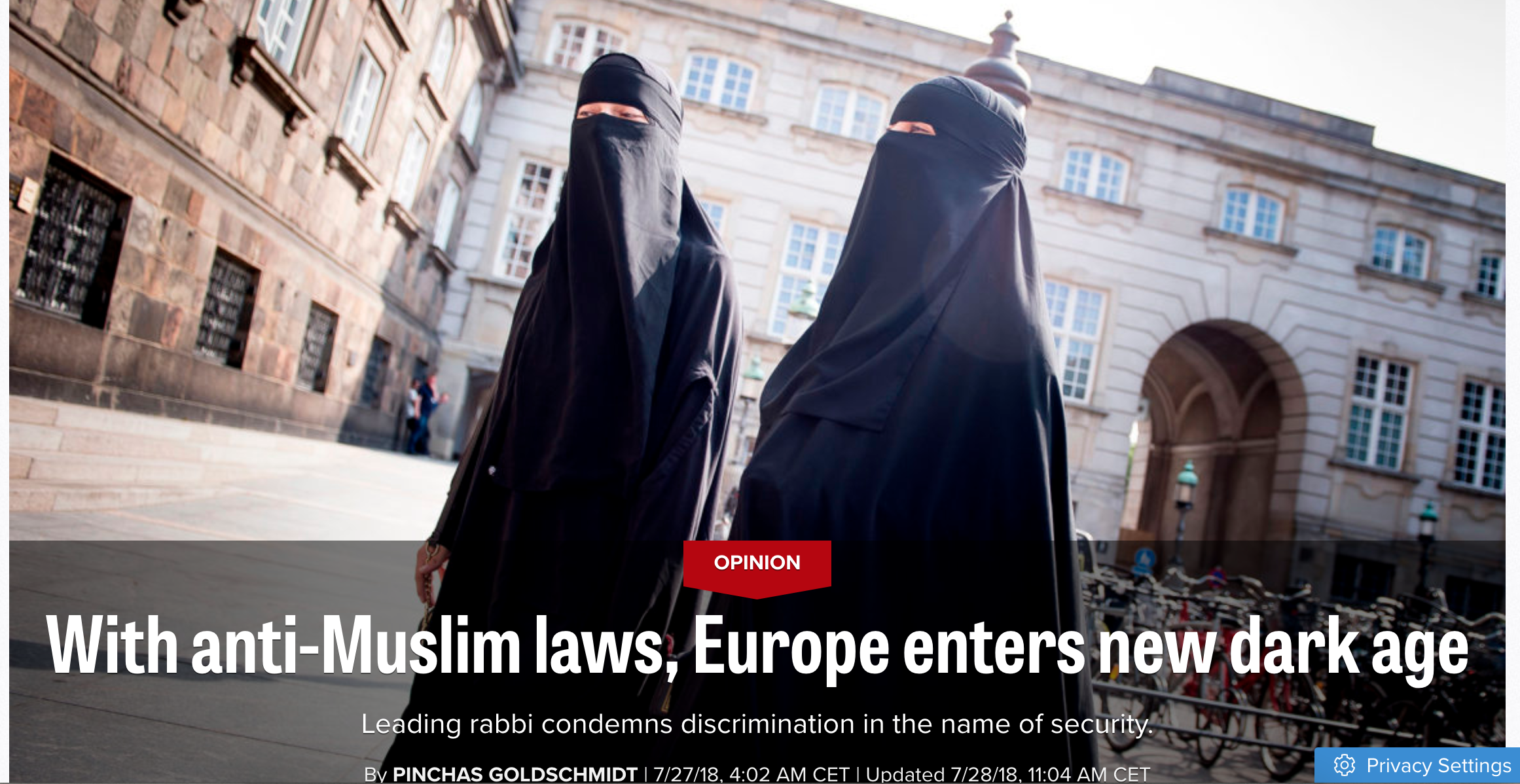
Politico article related to the topic

https://www.politico.eu/article/with-anti-muslim-laws-france-denmark-europe-enters-new-dark-age/

Yet, the most prominent factor currently creating social rifts is the economic hardships and unemployment in Europe. These negative social factors typically breed resentment for perceived outsiders. This resentment can be seen in the shift in European politics towards more radical officials (example above). Ramadan argues that in order to combat this, more action and dialogue must focus on contributions to society and developing alongside European society.

Sources:

Hunter. Islam, Europe Second Religion. Preface & Introduction Ch. 11 Europeanization of Islam by Tariq Ramadan 207-18.

Justin Vaisse. “Muslims in Europe: A Short Introduction,” pdf .

Blog #7 Islam in Europe: Who is more afraid of who? And why are they afraid at all?

By: Lana Henderson

Justin Viasse in the article “Muslims in Europe: A Short Introduction” discusses four myths that are circulating about the Muslim population in Europe. One of these myths is that demographically there is a rise of Muslims to the point of them surpassing the already existing population. Viasse discusses that this is untrue because when looking at the strengthening regulations on immigration there is a very low chance that Muslims would have the opportunity to grow any bigger than around five percent of the population in these countries. Another myth discussed is that the Muslim population is foreign to European customs and therefore would not be able to assimilate into the society’s they join. Viasse discusses that European and Muslim cultures have already had many interactions throughout history even to the point of having some Muslim practices integrated into current European society. There is also a need to distinct between culture and religion and although there are many connections between Islam and middle Eastern cultures there are also many proudly European but are also practicing Muslims. This leads into the next myth of discussing the idea that there a specific identity tied to being a Muslim and they are an easily categorized group. Viasse discusses that this is common within the way Muslims are discussed in the European media where they are often demonized or talked about in a light that depicts Muslims in a us vs them manner. The final myth is tied to this one discussing the idea that Muslims in Europe are a hostile and unified group. Viasse discusses that there is a lot of division within Islam with different sects and ethnicities and political identities. In this way Muslims are often believed and perceived to be a group within the Middle East that are trying to take over Europe on a unified front when really it is a religion that is practiced differently by many people all over the world.

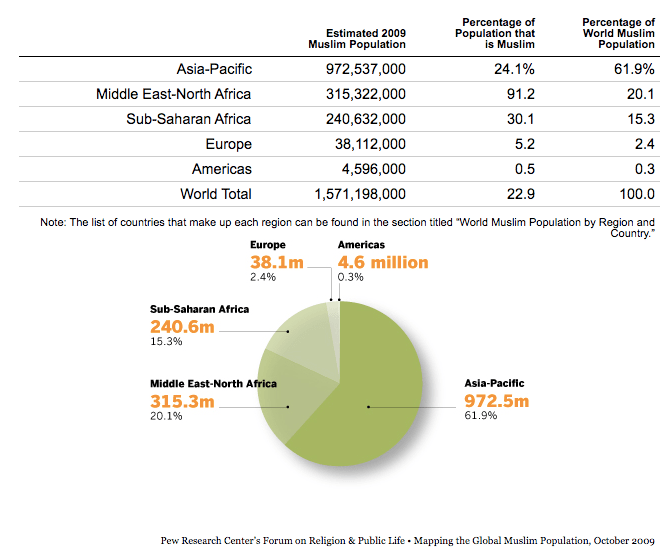
This image looks at global Muslim demographics. This image is from Pew Research

In the text by Shireen Hunter discusses the need to make distinctions between Islam as religious or political due to different systems. When discussing Islam in a religious context you first need to look at the Quran to understand the principles that guide this religion. Therefore, a Muslim in the religious dimension is someone who follows the practices set within the Quran, similar to Christianity and the Bible or Judaism and the Torah. Though hunter things it is important to make it clear that whether someone follows the Quran or not if someone characterizes themselves as of that faith than they are, and it cannot be only defined by how much they incorporate the Quran into their lives. When looking at Islam in a political context there is a look into the rules stated by the Quran and implementing them into society’s rules and looking at the words of the Quran to interpret them into the modern society. One of the major notable differences is that within religion is really controlled by the individual who follows the faith and in the political dimension there is social and even sometimes governmental consequences of not following the word of the Quran.

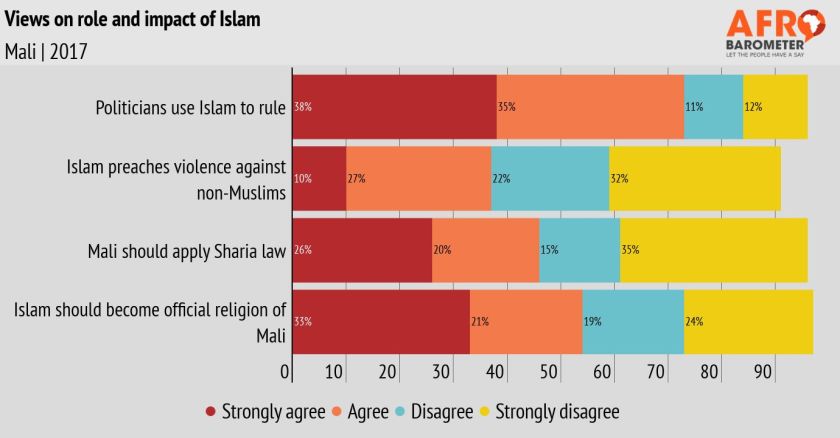
This image shows Malaysian feelings about Islam in their country as a religion and political institution. This image is from afrobarometer.org

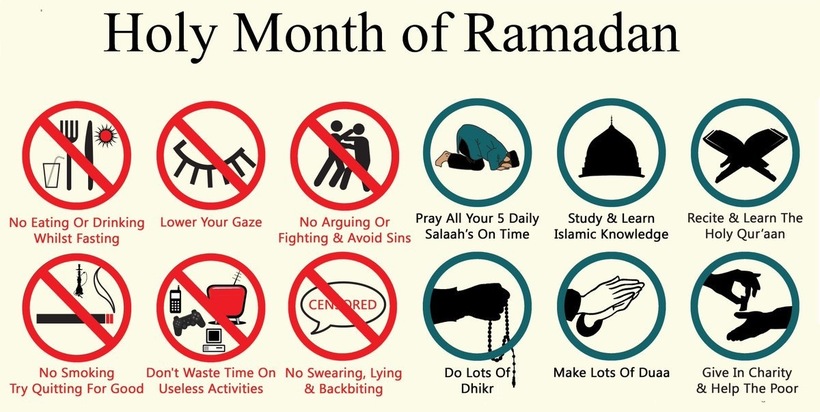
One of the problems that is faces in education and social rifts in Europe due to the educational emphasis on standard math, science and reading and there is a loss of understanding other cultures. Due to this there is a population of children and adults who have grown up with racist of xenophobic ideas due to the us vs them mentality instilled by the media added by a lack of educational systems aiding these social tensions. This leads to a division of communities with both sides being less willing to integrate into each other’s communities for fear of the unknown or the stereotypes they have learned to identify these groups with. Due to this there is a greater tie to religion in these European cultures to the point where even European born Muslims face in not feeling included into their own country’s identities due to the religion they practice. Ramadan is a Muslim holiday that incorporates the principles of Islam established by the Quran. Unlike what may be circulated in the media when it comes to Islam these principles guide Muslims to engage in peace and knowledge. There is a principle within the religion to educate on other religions and cultures due to being able to coexist peacefully through a mutual understanding and respect from both sides. Islam preaches the acceptance of others and a celebration of the things that make us different because unlike other mentalities Muslims see a deeper connection to their own religion and culture through being knowledgeable about others.

This image looks at the practices during the celebration of Ramadan. This image is from HuffPost

Resources

AD211: Malians Split on Role of Islam in Country, but Majority Feel Politicians Use Religion to Rule | Afrobarometerhttp://afrobarometer.org/publications/ad211-malians-split-role-islam-country-majority-feel-politicians-use-religion-rule. Accessed 12 Mar. 2019.

Almontaser, Dr Debbie. “Ramadan in the Workplace.” Huffington Post, 3 June 2017, https://www.huffingtonpost.com/entry/ramadan-in-the-workplace_us_593236d0e4b00573ab57a392.

Hunter. Islam, Europe Second Religion.

Sardar & Davies. Islam.

Viasse, Justin. Muslims in Europe: A Short Introduction,” Pdf on Canvas-Islam in Europe.https://missouri.instructure.com/courses/18213/files/3732585?module_item_id=1104158. Accessed 12 Mar. 2019.

The Right Side?

By Amber Jones, 3/5/2019, Blog Post #6

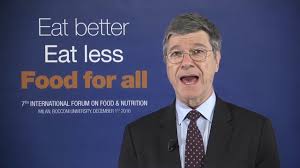
The debate on development is one of intrigue and deserves the spotlight among the economic community. When deciding “sides”, I really believe in Jeffery Sachs. His ideals are optimistic, and lead to believe that improving development in countries where poverty is a large problem will allow the people in these countries to improve their quality of life and help reduce poverty. Sachs helped oversee the Millennium projects works while serving as the director of the United Nations, as well as being the director of the UN sustainable development solutions network. I believe his work with the UN and seeing this issues upfront help shape his economic views, and lead his work to show that development helps these countries reduce their poverty rates. In a great example that we have discussed in previous weeks, programs like the millennium villages help these people improve their situation. In Mali alone, people were brought more irrigation access, more healthcare access, and better ways to financial serve their families. Programs like these are what Sachs believes in and helps put into effect. His views that development can be sustainable are what these countries need, and we need to be able to build upon them to help the poverty stricken areas in Africa. Sachs promotes forums not only on economics and financials, but also how we can aid poverty stricken countries in their food and lifestyle habits. He also helps these forums illustrate how simple it could be in theory to use food more efficiently and feed the world, so to speak.

Now, even though I believe Sachs has the upper hand, William Easterly brings up a good point in the debate. Easterly claims that Africa should be left alone. Obviously this is in contrast to what Sachs is arguing, but there is some truth to Easterly’s opinion. With the projects and developments that have already been implemented in Africa, the countries need to be open to free trade and industry, and learn how to utilize the new democracies that are forming. Thanks to Sachs ideas and projects of aid, many of the African countries have the tools to reduce the amount of poverty, but the countries need to learn to do it on their own, or they will never break the cycle.

In looking at how Banerjee and Duflo look at the SDG goals, we can see that they do address the needs of the countries. But even though they give ideas to achieve sustainable development, the ability to end poverty is far from attainable right now. One big reason is that while governments are moving towards democracy, many still have corrupt portions of their governments. Not only that, but many areas still suffer from poverty traps, and cannot break out of the cycle. These reasons can be due to poor farming, poor resources, bad governments, or lack of resources.

The solution? There are many that we can look at, and help promote. We first look at some of Jeffery Sachs ideas. The millennium goals helped achieve development in certain parts of certain countries within Africa. We go back to this idea of the Millennium villages, and realize that the improvements made they made can be made sustainable, as long as they are given appropriate resources. In Mali alone, the villages that were chosen to be a part of this project saw increased growth, healthcare, a reduction in malaria, and an increase in wages for those who were suffering in poverty.

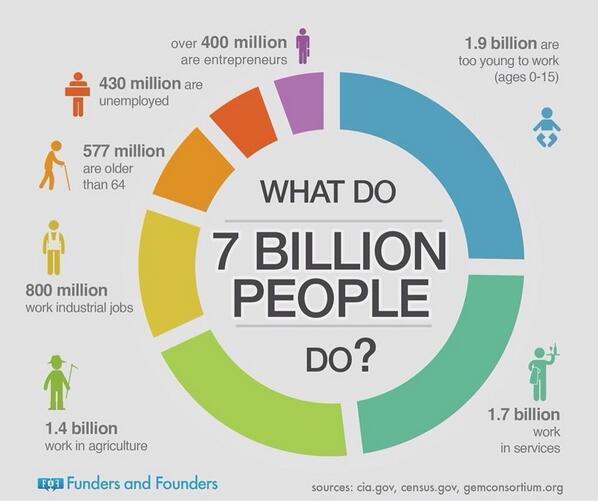
Not only do the millennium projects give hope into the SDG’s, but we also have to look at the monetary solutions. When we researched micro – credits last week, these payment methods and investments tend to aide the countries and the poverty stricken in them in ways that most banks wouldn’t. By focusing on the needs of those suffering in severe poverty, the development of appropriate funding for farming needs or other familial sustaining is now attainable for these. The only problem with some of these companies, is that they are on the verge on bankruptcy. There needs to be more initiative and funding for these programs so that they can return more to the communities they serve, and gain the trust of the citizens that they have lost. The image below reminds us the magnitude of the world population and how industry affects us. 1.4 billion people alone work in farming, and to be able to help sustain these people helps aid those who can’t work, like the 1.9 billion too young, or the 577 million who are elderly. Micro – finance works to help these people, and help relieve the stress of being severely poverty stricken by investing in them, so that they can contribute more to their own families and communities.

Image result for microfinance

Blog Post 6 – Where do we go from here?

by Jacob Feist

Part 1: Funding Democracy

“Many forms of Government have been tried, and will be tried in this world of sin and woe. No one pretends that democracy is perfect or all-wise. Indeed, it has been said that democracy is the worst form of Government except all those other forms that have been tried from time to time.”- Sir Winston Churchill

In the conclusion of Banerjee and Duflo’s “Poor Economics”, the authors outline the arguments related to foreign aid. Using a culmination of arguments explained in the earlier chapters, the authors reveal the determents and benefits of the current foreign aid model. Currently, many organizations, including the United Nations, heavily fund development efforts in struggling nations. These programs target key initiatives for the betterment of citizens in each nation. However, there are indications that perhaps these initiatives should target the nation, rather than the citizen.

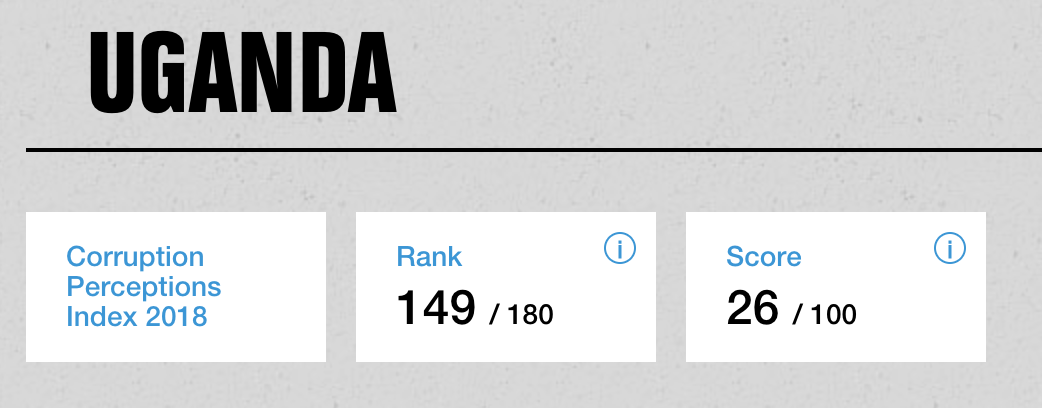
The fundamental issues plaguing many developing nations prevent these nations from maximizing their potential. The main culprit is government corruption, as these officials often use development projects are ways to accept bribes. In Uganda, ~86% of aid dollars towards education programs never made it to the schools. Rather, 86 cents of every donation dollar actually funded government corruption and bribery. Thus, until political institutions are reformed, it is impossible to create economic change.


Uganda’s Corruption Index Ranking & Score
https://www.transparency.org/country/UGA

Fortunately, there are potential solutions to reduce corruptions. Mainly, increasing transparency within communities and the media creates stark reductions in embezzlement. In Uganda, auditors were sent to analyze the finances of industrial projects. Their mere presence reduced bribery by 33% in the region. Additionally, when newspapers began reporting about the education corruption scandal, embezzlement went from 86% to 20%. Hence, economists like Jeffery Sachs argue that increasing transparency is a necessary part of development programs.

However, renowned economist William Easterly believes that in the current state of Africa, no intervention is the best solution. Easterly insists that we must encourage a completely free-market, unburdened by international interests to solve these issues. This will create an environment in which only the most successful entrepreneurs prosper. As these businesses prosper, industry will be created with no need for external funding. Additionally, we must not let aid money create political influence. Many citizens have displayed disinterest for western health-care and education systems. Easterly also cites the United States intervention in Iraq as the disaster proving that forcing democracy into a region creates more unrest. Thus, we must let the residents of the nations create their own solutions, solutions they will support. Easterly labels this theory the, “7 billion experts [taking] charge of their destiny.”

Easterly’s article addressing his rivalry with Jeffery Sachs and stance on foreign aid

While I agree that the current method for supporting education and health care are flawed, I do feel that intervention is necessary. However, the intervention should focus on creating political allies with progressive ideologies. An outline for this solution would be a committee of experts creating a non-profit focused on political support. This organization would find strong members of the Cheetah Generation and fund their campaign. Moreover, this organization could search for popular news outlets and fund their efforts for more transparent and accountable governments. This put countries in a position to elect democratic officials focused on creating lasting change. Over time, this would allow democracies to rise and change to occur internally.

Part 2: The Problems & Solutions of SDG 1 & 2

SDG goals 1 and 2 focus on ending poverty in all forms everywhere and achieving food security and improved nutrition. Banerjee and Duflo discuss the issues and proposed solutions to each goal.

SDG Goal 1

The Problems: Ending poverty in all forms is far from an achievable solution at this time. Banerjee and Duflo explain that with the proliferation of government corruption, development goals cannot be full achieved. Additionally, poverty traps, until properly addressed keep people in a vicious cycle of debt and suffering. In order to properly eradicate poverty, corruption must be thwarted and individual poverty traps must be targeted and solved.

The Solutions: The most attainable solution at this time is microfinancing and microcredits. Banerjee and Dulfo displayed the advances in technology and marketing and their impact on society. Eventually, with universal availability anyone in any nation could save money, afford insurance, and secure loans for new business. However, this solution is dependent on the success of these small businesses.

Banerjee & Duflo

SDG Goal 2:

The Problems: Banerjee and Duflo explain that many nations have installed programs to eliminate food insecurity. There is access to nutrient dense grains at affordable prices. However, the reality is that as wages increase, people purchase better tasting food not more nutrient dense food. Thus, the problem in malnutrition appears to be more education and marketing related than availability.

The Solutions: Creating programs dedicated towards educating families about calories and nutrients are critical. Additionally, there should be programs focusing on properly budgeting towards food. Banerjee and Duflo also make an interesting observation about genetically modified foods. They argue that efforts should be made on creating tasty genetically modified foods that are nutrient dense. The economists believe that if the food is actually good, the demand will develop naturally.

Blog #6 Is aid helping or hurting? Maybe a little of both

By: Lana Henderson

I side most with Jefferey Sachs on this debate, though there is one point that Easterly makes that I agree with. Sachs promotes a policy where aid is directed toward specific things that can be easily fixed and make a lasting impact through generations. These things could be as simple as vaccines, malaria nets, clean water, infrastructure and many other things that are small but are also inaccessible and causing significant death in some countries. The problem is with Sachs small scale impact following his plan he didn’t take variable recordings to make sure that his change could be noted. One thing that Sachs is notable of is the poverty trap which is institutional barriers that keep people from being able to raise in class or really even get out of “poverty”. When looking at racism there has be an understanding that at its core it is an institutionally backed oppressor of a certain race. So you can’t look at Africa now or many countries without first considering their colonization history and what influences that had on their economy and society.  One reason I agree with Easterly is because of his free trade ideals, these could help a market flourish in these times because sadly fair trade though it is morally better and many times better for the environment its more expensive than the free trade market. Though many times the Free trade market is able to be so cheap due to its use of labor laws and company laws that if they were implemented in countries like America many people would be outrage. Many people admit though that even though that may be the case they are not willing to give up their cheap prices. My fault with Easterly is that he isn’t really as open to the idea of the poverty trap and its lasting affects but instead promotes his plan that these countries are completely self-sufficient if we back out we see that they face these extremely hard plights every day  and find a way to live. Although overall Easterly believes that countries would benefit greatly if we cut off aid completely, so they weren’t so dependent on other countries. Both sides and I can definitely agree though the changes with aid or without make little difference in a place where there is a government that is not protecting the wellbeing of its people and instead has separate interests.

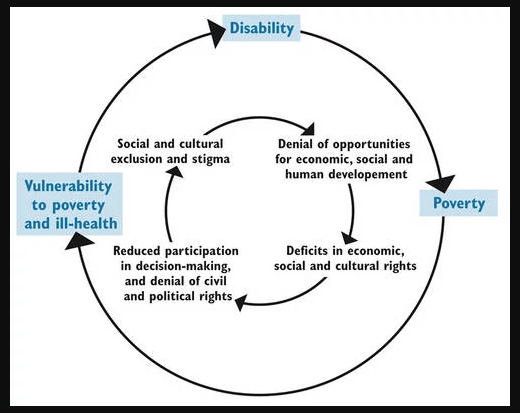
This image shows things that create a poverty trap. This image is from Hhealthintamilnaduindia

This reaffirms the debates from earlier weeks that though Jeffrey Sachs has a plan that in theory seems like it could be a good start to creating lasting change in African countries he failed to collect the data to back this up. Due to that many other economists can look at these economies and suggest other things that came into play that made a difference such as the digital age and the jobs that it brought with it. Easterly believes that countries are able to grow naturally and that often aid ends up making no notable impact in some places. The Bookings article discusses some the same ideas due to the choice of the western aid companies there are certain countries that are known as donor darlings that receive a lot of international attention and aid and may be said to have a better chance at success than donor orphans who are not as often given the continual and consistent attention that the darlings get to benefit from. The article further goes on to discuss how these are the ways that aid can fall off track for certain countries and though there has been a notable decrease in the amount of poverty listed through SDG goals there are certain areas that have made major impacts to this number while others are not having the same fate.

This image is the SDG banner. This image is from the UNDP

Banerjee and Duflo discuss micro credits as a solution that could help countries grow business that were sustainable while also incorporating aid in a way that made them investors instead of aid. As Easterly discussed, there can be problems were aid when not used sufficiently will not be as successful as people had hoped in their donations. This changes with micro credits because instead of seeing it as money lost people can see it as money invested and watch how their money is making a direct change in business or in the market of the businesses that they help. One problems with this is that there is a media outlook on many of these same countries that portrays them as helpless or unable to get it together when they are given a chance/aid. There is a lack of telling the full story of Africa when there is a one sided story that is shown and people don’t want to invest in a place that they think is going to be unsuccessful and will end in them losing money and helping no one. Chimamanda Ngozi Adichie addresses this in her TED talk title “The danger of a single story”. She discusses how she realized she and her country was viewed by those in the developing world. People see the continent of Africa as this hopeless poverty filled place because that is the only story they have ever been told. Chimamanda discusses how the Nigeria she grew up in was very different than the Nigeria her peers at university in England had been told about.This is the talk addressing the need to look at countries through more than just one point of view. This was found on the TEDtalk website.

Resources

Adichie, Chimamanda Ngozi. The Danger of a Single Storyhttp://www.ted.comhttps://www.ted.com/talks/chimamanda_adichie_the_danger_of_a_single_story?language=en. Accessed 5 Mar. 2019.

Earth Institute. Jeffrey Sachs on CBCYouTubehttps://www.youtube.com/watch?v=CNWzYy186W8&frags=pl%2Cwn. Accessed 5 Mar. 2019.

“Poverty Traps.” Health in Tamil Nadu, India Wikihttps://healthintamilnaduindia.fandom.com/wiki/Category:Poverty_traps. Accessed 5 Mar. 2019.

“Sustainable Development Goals.” UNDPhttps://www.undp.org/content/undp/en/home/sustainable-development-goals.html. Accessed 5 Mar. 2019.

World Affairs. William Easterly: Freedom as a Solution to PovertyYouTubehttps://www.youtube.com/watch?v=ibJHEJrOs2s. Accessed 5 Mar. 2019.

Post 5 – The Wealth of Africa

By Jacob Feist

Part 1 The Arguments For and Against Microcredits

In Poor Economics by Banerjee and Duflo, the authors outline the financial landscape in Africa. Their focus is on the concept of microfinancing and its potential benefit to developing nations. The key argument supporting microfinancing is that poor people in developing nations are constantly worrying and preparing for potential disaster. They rely on costly and potentially ineffective methods of savings. Thus, one can reasonably assume that there is a demand market for some sort of regulated borrowing and savings method.

Rutherford of the company SaveSafe explains that many families currently rely on savings clubs or self-help groups that allow multiple families to pool resources. Essentially, they are creating their own insurance float, proving that the concept is possible in developing nations. Additionally, many argue that as savings systems and financing systems become available, poor people would be able to create their own small businesses. Cases outlined by BRAC reveal that initial financing and basic guidance and education allows most people to create a revenue generator.

However, Banerjee and Duflo analyzed data sets of small businesses without BRAC guidance and concluded that the average small business in developing nations creates negative cash flow. Thus, leaving the business owner in the same positions as they were before the loan. This is compounded by the time and energy required to own and operate a small business. Additionally, the issues with microfinancing stem beyond the flaws in small businesses. Primarily, it is costly and risky managing small pools of wealth in developing nations. For a business, the cost of management will likely exceed the return on holdings. In countries, without systems of accountability, there is a risk that no one will repay their loans. Hence, to protect against risk banks would be forced to charge higher fees. These higher fees would create their own issues, as seen in the example of Jennifer Auma (Page 188). Her local bank’s withdraw fees negated any benefit of storing money.

Part 2 & 3 Microcredits in Tanzania

Microcredits were introduced in Tanzania in the 1990s and have been slowly integrated into society. Today, there are several banks offering microfinancing loans and savings for poor people in Tanzania. In 2001, these banks joined together under TAMFI, Tanzania Association of Microfinance Institutions. Together they work to develop the institutions themselves, government assistance, and microcredit availability. Moreover, the institution has proven successful, helping fund 1.2 million people with loans and savings.

TAMFI Logo

Yet, there is still concern about the long-term success of these institutions. The World Bank analyzed the microfinancing landscape of Tanzania in 2003 and found some troubling results. In talking with government and bank officials, they found no discernable strategy for further developing their relationship or expanding the services of these banks. The World Bank was also displeased with regulatory bodies ability to promote transparency and accountability within these systems. Their biggest concern is human capacity. As the demand for microcredit institution increases as does the need for skilled labor in the banking sector. At this time, Tanzania is lacking skilled laborers to work in the microfinance and microcredit industry.

Part 4 Reflecting on “The Road to Ending Poverty”

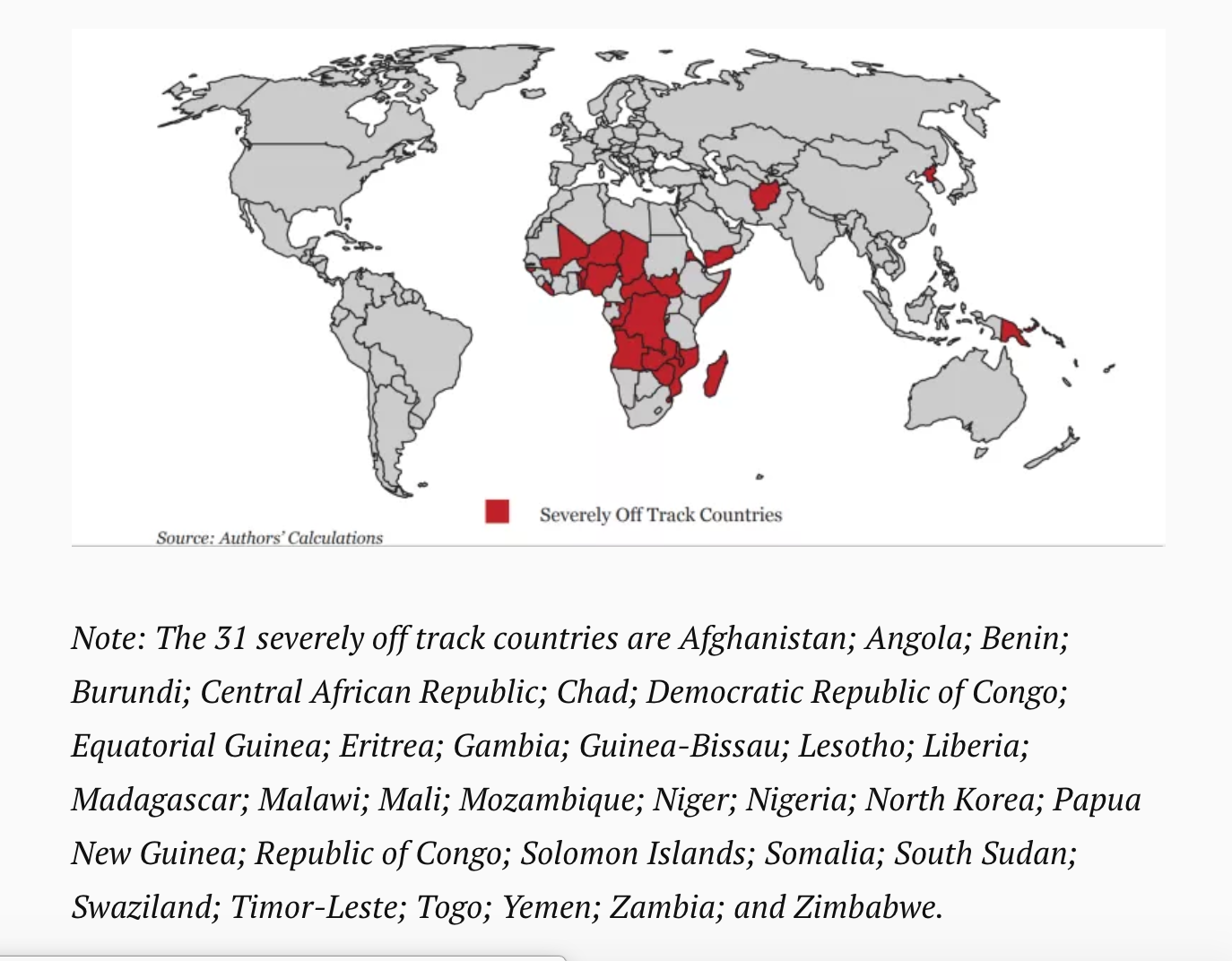
In the article “The road to ending poverty runs through 31 severely off track countries”, Gertz and Kharas outline a key issue in the fight against poverty. Many of the numbers contributing to the staggering drop in poverty is occurring within a few key nations. Countries like China and India have had huge economic booms leading to greater GDP and less poverty. The article cites that “7 of 10 countries cut their poverty headcount ratios by 70%.” While these are incredible results that will benefit large portions of humankind, they are misleading in outlining the overall success of the SDGs.

The countries experiencing the greatest success in eradicating poverty are typically those experiencing the greatest economic success. While this may appear obvious, it creates a dubious future for the remaining countries experiencing critical levels of poverty. The authors highlight 31 countries severely off track from meeting their goals. These countries range from radically unstable and underfunded to completely stagnant and receiving generous donations. Thus, the solution extends past simply promoting democracy or outside funding.

The 31 STOCs outlined by the article

https://www.brookings.edu/blog/future-development/2018/02/13/the-road-to-ending-poverty-runs-through-31-severely-off-track-countries/

It also presents a glaring need for the SDGs and non-profit thinktanks across the world. Clearly, there is a need to adapt. Strategies must be developed for each of the remaining SOTC. While general SDGs and development projects have assisted many communities, it is clear that these cases follow no trend and require individual help. Hence, I feel that a summit similar to the original MDG meeting would be beneficial. There should be tasks and goals related to each nation, addressing critical needs, funding deficits, and areas of change. Moreover, in nations that funding is proving ineffective, reallocating recourses could prove effective.

Part 5 Technology as an Agent of Change

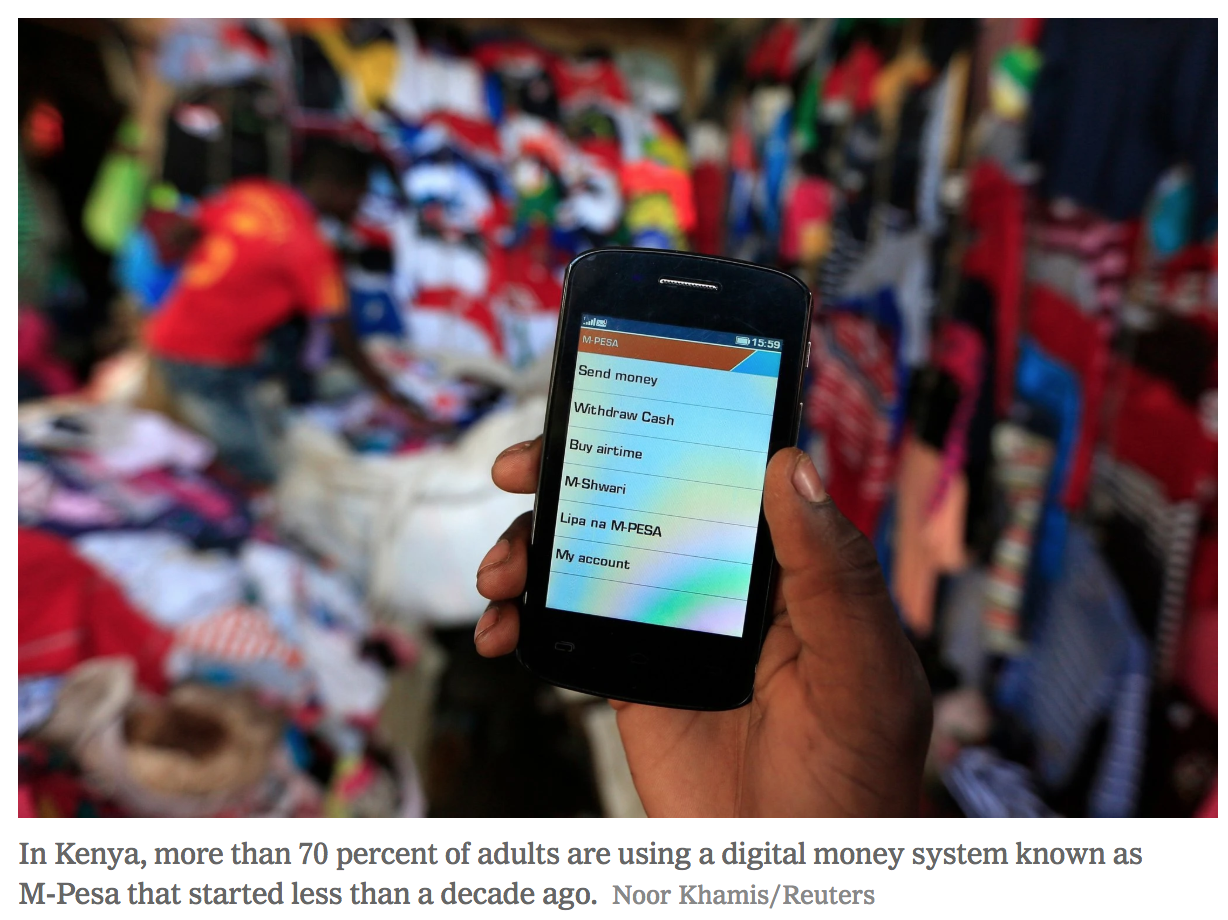
Technology is radically changing the way people spend and save money. McKinsey Consulting attributed a 6% rise in global spending to technology. Primarily, they are seeing enormous changes stemming from cell-phone use in developing nations. A New York Times article explains, “70% of adults are using [M-Pesa] that started less than a decade ago.” These microlending and financing institutions have created a spike in the transferring of funds and creation of small businesses.

Image from the New York Times article

https://www.nytimes.com/2016/09/22/business/dealbook/cellphones-not-banks-may-be-key-to-finance-in-the-developing-world.html?rref=collection%2Ftimestopic%2FMicrofinance&action=click&contentCollection=timestopics&region=stream&module=stream_unit&version=latest&contentPlacement=3&pgtype=collection

Additionally, a 2017 World Bank Symposium outlined the success of microfinancing. The group of 35 tech and finance experts worked to explain the impact of technology and microcredits. They discovered six key elements impacted by the changes:

  1. Customer Centricity
  2. Reducing operational risks
  3. New business models
  4. Partnerships and collaboration
  5. Building trust
  6. Customer protection

Part 6 Reflecting on “Africa Poor Stealing Wealth”

The article outlines an important element preventing the distribution of wealth in Africa. Much of the wealth and recourses being developing in the continent is being exported or stolen. The facts detailed by Dearden present undeniable proof that industry is available. $203 Billion dollars left the country last year, including $68 billion dollars in avoided taxes. Additionally, $29 billion is lost annually to illegal wildlife and logging activity. This is exacerbated by the countries ultra-wealthy holding money in international tax havens.

Thus, it is clear that a solution must be developed. The author argues for repatriations and redistributions of wealth. However, I cannot fully support these solutions. Radical solutions often create radical problems. Attempting to take and redistribute the wealth of the ultra-wealthy will cause them to leave or store more money off-shore. Moreover, attempting to reduce tax havens is a noble cause, but one that would not be achievable without the backing of the entire international community. I believe the solution should start simple and then build outward. First, attack the explicitly illegal activities. Use funding to prevent illegal wildlife activity and outright tax evasion. Closing these cash flows could create an increase of almost $100 billion dollars.

Sources:

http://documents.worldbank.org/curated/en/521691468782105272/Micro-finance-regulation-in-Tanzania-implications-for-development-and-performance-of-the-industry

http://blogs.worldbank.org/eastasiapacific/transforming-microfinance-through-digital-technology-in-malaysia

https://www.aljazeera.com/indepth/opinion/2017/05/africa-poor-stealing-wealth-170524063731884.html

http://documents.worldbank.org/curated/en/521691468782105272/Micro-finance-regulation-in-Tanzania-implications-for-development-and-performance-of-the-industry