By Jacob Feist
Part 1: The Myths
In Justin Vaisse’s paper, “Muslims in Europe: A short introduction”, he outlines four myths pertaining to Muslims in Europe and the negative ramifications of each misconception.
Myth #1: Being Muslim completely encompasses one’s full personality and ideologies. This myth creates the stereotype that all Muslim immigrants have the same priorities and beliefs.
Myth #2: Muslims in Europe are all foreign entities or arrived from the Middle East. This myth stripes many Muslims native to the region of their European identity.
Myth #3: Muslims in Europe are a “cohesive and bitter group” (https://www.foreignaffairs.com/articles/europe/2005-07-01/europes-angry-muslims). Vaisse explains that there are geographic, social, and political dimensions to Muslims.
Myth #4: The Muslim community is overtaking the European population. This myth creates the idea that the Muslim community is somehow separate from the native community. Additionally, it is archaic as the birthrates between immigrant and non-immigrant communities are moving towards equal.
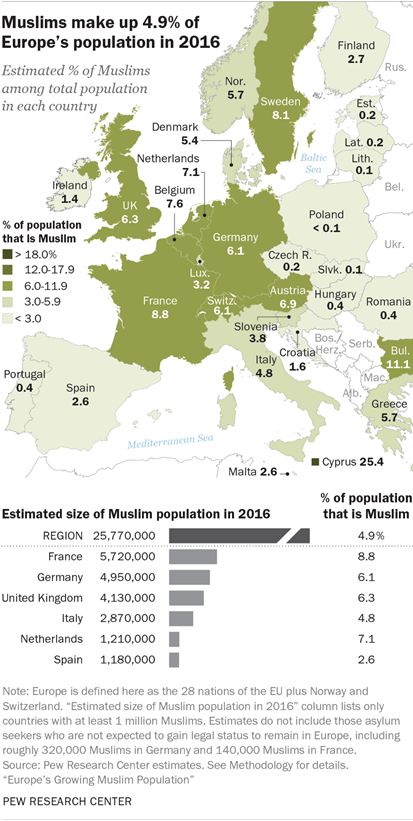
These myths create a toxic and contentious dynamic between Europeans and European Muslims. Ramadan explains that the mindset should be one that understands that Muslim is a fully integrated part of European society. Moreover, the religion is a way of life and political and social discussion cannot be fully realized until people are willing to educate themselves on the religious dimension.
Part 2: The distinction between politics and religion
In Hunter’s “Europe’s Second Religion”, the author outlines the importance between political and religious dimensions for Muslims. She explains that these dimensions are not the same, but that does not necessarily mean they create conflict. The religious dimension applies to the laws ordained within the Quran and the activities related to worship. However, the political dimensions relates to social affairs. The only universal connection is that the social affairs cannot interfere with the religious dimension. Thus, Muslims can have varying political, social, and economical beliefs. Moreover, Muslims have a “principle of original permission” stating that they may take what is good from other cultures. This indicates that over time Muslims will adopt certain positive aspects of European culture. Hence, the two communities must create dialogue and education to encourage the adoption of these positive aspects and the integration of Muslims into society.
Part 3: Education and Social Rifts
As mentioned in Part 1, discussions between native Europeans and Muslim Europeans have been hindered by a lack of understanding. Additionally, these dynamics have been strained by a series of perpetuated myths. Thus, rifts have been developed in the education and social systems within Europe. Ramadan explains that the rift is created because political and economic integration is expected without discussing the underlying cultural and religious differences. Currently, education is superficial without enough about understanding the true identity and core issues for Muslims within Europe.
Moreover, a social rift is being created because of a lack of understanding on Shari’a law. Often, Europeans view this system as method of the of asserting Muslim law in Europe. However, this could not be further from the truth. The author explains that Shari’a law is far more inclusive than just a system of law and penalties. In actuality, Shari’a law is a system dedicated to finding religion and faith in any location of community. Hence, this should be used as a method of inclusion and adaptation rather than tension.
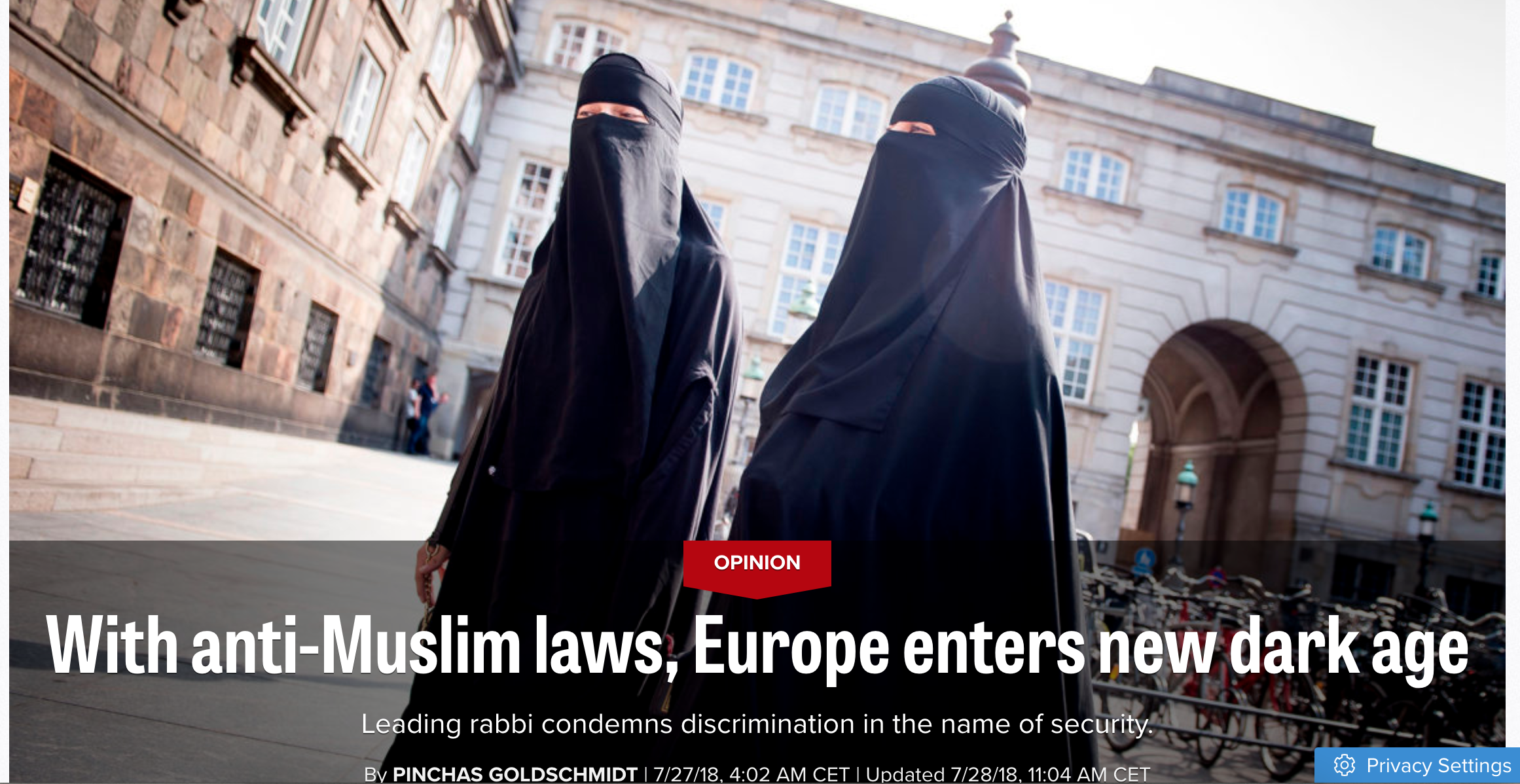
https://www.politico.eu/article/with-anti-muslim-laws-france-denmark-europe-enters-new-dark-age/
Yet, the most prominent factor currently creating social rifts is the economic hardships and unemployment in Europe. These negative social factors typically breed resentment for perceived outsiders. This resentment can be seen in the shift in European politics towards more radical officials (example above). Ramadan argues that in order to combat this, more action and dialogue must focus on contributions to society and developing alongside European society.
Sources:
Hunter. Islam, Europe Second Religion. Preface & Introduction Ch. 11 Europeanization of Islam by Tariq Ramadan 207-18.
Justin Vaisse. “Muslims in Europe: A Short Introduction,” pdf .

