by Jacob Feist
Part 1: Funding Democracy
“Many forms of Government have been tried, and will be tried in this world of sin and woe. No one pretends that democracy is perfect or all-wise. Indeed, it has been said that democracy is the worst form of Government except all those other forms that have been tried from time to time.”- Sir Winston Churchill
In the conclusion of Banerjee and Duflo’s “Poor Economics”, the authors outline the arguments related to foreign aid. Using a culmination of arguments explained in the earlier chapters, the authors reveal the determents and benefits of the current foreign aid model. Currently, many organizations, including the United Nations, heavily fund development efforts in struggling nations. These programs target key initiatives for the betterment of citizens in each nation. However, there are indications that perhaps these initiatives should target the nation, rather than the citizen.
The fundamental issues plaguing many developing nations prevent these nations from maximizing their potential. The main culprit is government corruption, as these officials often use development projects are ways to accept bribes. In Uganda, ~86% of aid dollars towards education programs never made it to the schools. Rather, 86 cents of every donation dollar actually funded government corruption and bribery. Thus, until political institutions are reformed, it is impossible to create economic change.
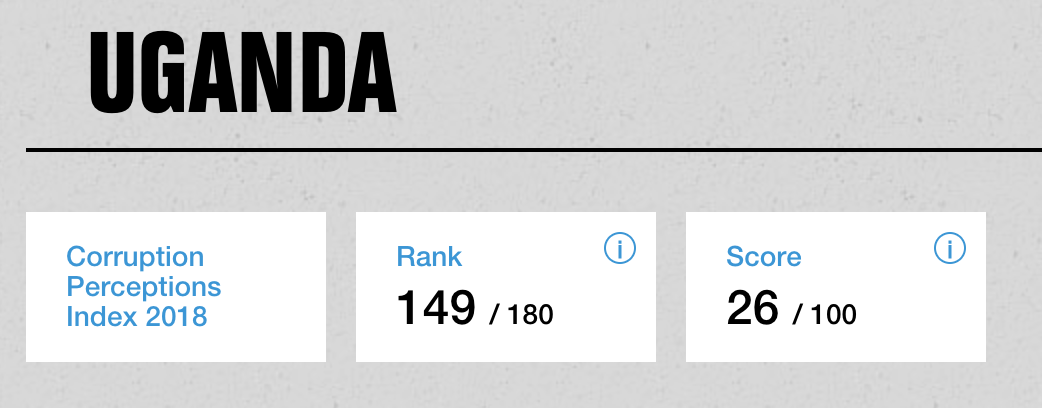
Uganda’s Corruption Index Ranking & Score
https://www.transparency.org/country/UGA
Fortunately, there are potential solutions to reduce corruptions. Mainly, increasing transparency within communities and the media creates stark reductions in embezzlement. In Uganda, auditors were sent to analyze the finances of industrial projects. Their mere presence reduced bribery by 33% in the region. Additionally, when newspapers began reporting about the education corruption scandal, embezzlement went from 86% to 20%. Hence, economists like Jeffery Sachs argue that increasing transparency is a necessary part of development programs.
However, renowned economist William Easterly believes that in the current state of Africa, no intervention is the best solution. Easterly insists that we must encourage a completely free-market, unburdened by international interests to solve these issues. This will create an environment in which only the most successful entrepreneurs prosper. As these businesses prosper, industry will be created with no need for external funding. Additionally, we must not let aid money create political influence. Many citizens have displayed disinterest for western health-care and education systems. Easterly also cites the United States intervention in Iraq as the disaster proving that forcing democracy into a region creates more unrest. Thus, we must let the residents of the nations create their own solutions, solutions they will support. Easterly labels this theory the, “7 billion experts [taking] charge of their destiny.”
While I agree that the current method for supporting education and health care are flawed, I do feel that intervention is necessary. However, the intervention should focus on creating political allies with progressive ideologies. An outline for this solution would be a committee of experts creating a non-profit focused on political support. This organization would find strong members of the Cheetah Generation and fund their campaign. Moreover, this organization could search for popular news outlets and fund their efforts for more transparent and accountable governments. This put countries in a position to elect democratic officials focused on creating lasting change. Over time, this would allow democracies to rise and change to occur internally.
Part 2: The Problems & Solutions of SDG 1 & 2
SDG goals 1 and 2 focus on ending poverty in all forms everywhere and achieving food security and improved nutrition. Banerjee and Duflo discuss the issues and proposed solutions to each goal.
SDG Goal 1
The Problems: Ending poverty in all forms is far from an achievable solution at this time. Banerjee and Duflo explain that with the proliferation of government corruption, development goals cannot be full achieved. Additionally, poverty traps, until properly addressed keep people in a vicious cycle of debt and suffering. In order to properly eradicate poverty, corruption must be thwarted and individual poverty traps must be targeted and solved.
The Solutions: The most attainable solution at this time is microfinancing and microcredits. Banerjee and Dulfo displayed the advances in technology and marketing and their impact on society. Eventually, with universal availability anyone in any nation could save money, afford insurance, and secure loans for new business. However, this solution is dependent on the success of these small businesses.
SDG Goal 2:
The Problems: Banerjee and Duflo explain that many nations have installed programs to eliminate food insecurity. There is access to nutrient dense grains at affordable prices. However, the reality is that as wages increase, people purchase better tasting food not more nutrient dense food. Thus, the problem in malnutrition appears to be more education and marketing related than availability.
The Solutions: Creating programs dedicated towards educating families about calories and nutrients are critical. Additionally, there should be programs focusing on properly budgeting towards food. Banerjee and Duflo also make an interesting observation about genetically modified foods. They argue that efforts should be made on creating tasty genetically modified foods that are nutrient dense. The economists believe that if the food is actually good, the demand will develop naturally.

