By: Lana Henderson
- What are the factors that classify as good news in Africa according to Radelet?
- In Africa there is an overwhelming rhetoric that the people live in chaos and suffering at all times. Therefore, whenever we see African countries in the news it is often to address a new issue or recurring problem they have been having keeping the idea that they are a continent in turmoil. The Radelet article discusses emerging countries who are breaking through these barriers and advancing through fundamental changes to their economic and political systems. Radelet classifies 5 fundamental changes that have lead to notable changes in the emerging good news countries of Africa. The first two go hand in hand being, the rise of more democratic and accountable governments and the introduction of more sensible economic policies. The following three are the end of the debt crisis and changing relationships with the international community, the spread of new technologies, and the emergence of a new generation of public and private leaders. The first factor has created a big difference through having democratic leadership, in the past some African countries had to overcome leaders who were corrupt and used force to get their way. With new leadership there has been a positive change to civil rights and freedoms which has allowed and created stronger political institutions. The second factor of more sensible economic policies has been able to get rid of economic mismanagement and led to a better balance between the private and public sectors. This also helped affect budget and trade deficits. The next big change is influenced by the former being the end of the decades-long debt crisis and changes to Africa’s relationship with the international community. There has been a shift between African countries and countries that would commonly invest in them due to a shift in process to pull themselves out of debt through choosing strategies that were country led rather than stipulations given by the IMF or World Bank that gave a lot of conditions that often left African countries unable to affect change in the ways they really needed from aid. The next factor is no surprise in a an increasingly advanced world technology has also made a profound impact on African countries. The internet is cutting the time it needs to share information and overcome geographical boundaries to receive critical information. This has also opened a new sector of jobs that where not previously available and have an increased influence on the betterment of life in the future of Africa. The last factor is the emergence of a new generation of policymakers, activists and business leaders. These are often people who were born in Africa but had international experiences especially in their education that has given them a global way to analyze the world and their countries place in it.
Millennium Villages
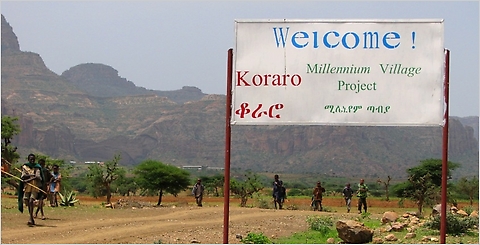
-Why was that particular village chosen? I chose to look into this village because Ethiopia unlike most other African countries was not under colonial rule in the same way it shaped a lot of their neighboring countries due to their powerful government. This made me curious what shift led to it being on the same playing field as many of the countries who are recovering from a colonial shift.
-What is the goal for that village? There is a beekeeping program being tested as a new source of income in this community. About 1,200 colonies have been introduced for honey business.
-What successes or failures have been recorded? There have been five health posts and six primary schools built as a result of new wealth in the area. They have also trained 80 women on how to manage poultry, dairy cows and fattening animals and trading textiles and grains. There has been a decrease of dropouts due to “girl’s club’s” being stablished in schools which encourage female education. 6,000 people have easier access to clean water. New irrigation techniques have diversified crops in this area as well as increased farmers income by 72 percent on average. A very big change will be the projects currently underway to construct roads.
-What do the critics say? One of the biggest themes introduced by critics is the idea of creating aid dependent rather than actual self-sustainable. There is a lack of a system available to chart the progress of the Millennium villages in context to surrounding similar communities. Many critics have also said that because of Sachs close relation to the issues it has clouded his judgement for reality and facts when he presents his arguments for why his way will be a successful way to end poverty. Some have gone as far as to say that due to this project he has lost his credibility as a once extremely credible economist to an aid propogandist.
Ethiopia GDP: 80.56 Billion (2017) , GNP: 198.1 billion PPP dollars, HDI: Index= .463 Rank= 173,
-How are local, national and global issues addressed and involved? There are other African countries that have asked for guidance implementing some of the MVP protocols.
-And finally, what do you think: Is it a viable project towards ending poverty? I think this is dependent on many other factors including how connected they become with other areas around them. One thing that is a negative factor for them right now is that they are effectively cut off from many other areas but if these policies are making notable change at faster rates than villages around them are able to might there be an influx of a population looking to get in on their notable success. Though majority of the Millennium Villages site pages have not been updated since 2013 so it’s hard to tell what change has been made since then.
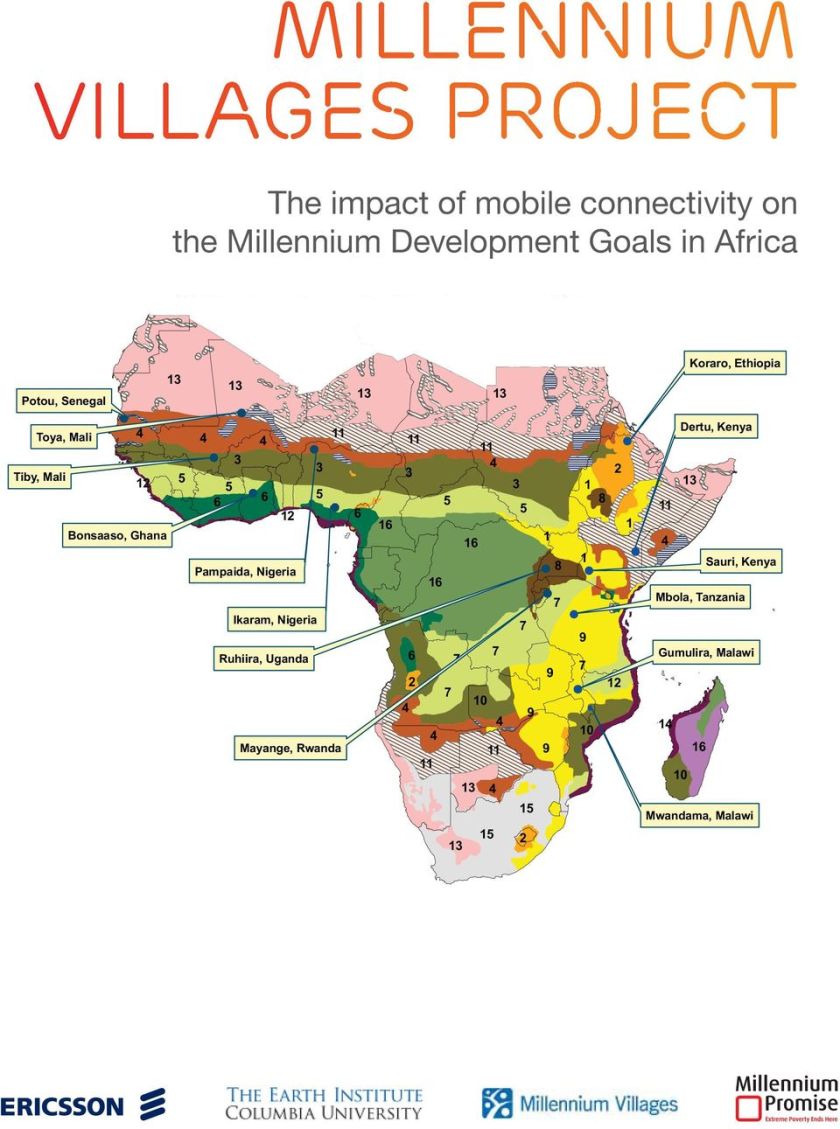
-Why was that particular village chosen? I chose this village because I have done a service trip to a different area of Senegal in Palamarin Fakou but was curious if both of the regions had seen similar problems to the ones I saw in the villages I visited.
-What is the goal for that village? The goals for this village were to get more stable infrastructure
-What successes or failures have been recorded? Some of the notable successes of this community has been their ability to produce high-value crops, dairy farmers have received beneficial training, there is newly constructed clinics and new jobs for trained nurses, teachers have received training on personal hygiene and sanitation. Some of the most notable changes to me listed were the federation of 125 women’s business to boost entrepreneurship and the ability for clean piped drinking water to reach nearly the whole population.
-What do the critics say? Critics say while the project has been able to gather a lot of celebrity attention that doesn’t necessarily mean that it is a program that is effective. Due to the lack of systems integrated at its start to track progress it is very hard to say whether or not this program has been effective. There has been insufficient data collected and any production of statistically significant results. There are also many investors who feel that there is an outpour of talk about the model being a great one to get you on board but once you have donated a lot of money there is silence and constant reasoning behind why the system doesn’t look like the one pitched to investors. It also seems that money that was set to be used in certain places isn’t being used correctly found in a study done on the Ghana villages that tested donations versus the amount that could actually be seen being invested into households.
SENEGAL GDP: 16.37 billion (2017), GNP: 41.5 billion (2017) per capita: $2,384, WDI, HDI: index= .505, Rank: 164
-How are local, national and global issues addressed and involved? African countries that have asked for guidance implementing some of the MVP protocols and surrounding villages probably reap the benefits from having access to more clinics, schools and other infrastructure that was previously even further way than the next village over.
– what do you think: Is it a viable project towards ending poverty? According to world factbook there is a youth population that has not turned into successful human capital. There is not a lack of children but instead a lack of education that gets children ready to participate in the work force beyond their parents positions or homemaking. The fore I think this would be lot more successful if instead of focusing on infrastructure they focused more on giving the children versatile education. This is hard though because many of the projects that Sachs instituted have focused on fixing infrastructure and getting clean water. These are obviously necessary goals though with no one having access to clean water would make a notable difference with the amount of time children could be in school versus having to get clean water. Overall, I think these are complex issues and tackling the direct problem doesn’t necessarily mean it will make a difference because of other issues that are limiting society from being able to reach their potential.
Resources
| Human Development Reports. http://hdr.undp.org/en/countries/profiles/ETH. Accessed 5 Feb. 2019.
—. http://hdr.undp.org/en/countries/profiles/SEN. Accessed 5 Feb. 2019.
Africa :: Ethiopia — The World Factbook – Central Intelligence Agency. https://www.cia.gov/library/publications/resources/the-world-factbook/geos/et.html. Accessed 5 Feb. 2019.
Africa :: Senegal — The World Factbook – Central Intelligence Agency. https://www.cia.gov/library/publications/resources/the-world-factbook/geos/sg.html. Accessed 5 Feb. 2019.
Hirsch, Afua, and west Africa correspondent. “Jeffrey Sachs Fast-Tracks New Millennium Village Project in Ghana.” The Guardian, 31 Aug. 2012. http://www.theguardian.com, https://www.theguardian.com/global-development/2012/aug/31/jeffrey-sachs-millennium-village-project-ghana.
Millennium Villages | Koraro, Ethiopia. http://millenniumvillages.org/the-villages/koraro-ethiopia/. Accessed 6 Feb. 2019.
Millennium Villages | Millennium Villages Project. http://millenniumvillages.org/the-villages/. Accessed 6 Feb. 2019.
Millennium Villages | Potou, Senegal. http://millenniumvillages.org/the-villages/potou-senegal/. Accessed 6 Feb. 2019.
Millennium Villages | USAID Awards $1.1M for Solar Irrigation in Senegal. http://millenniumvillages.org/field-notes/usaid-awards-1-1m-for-solar-irrigation-in-senegal/. Accessed 6 Feb. 2019.
Starobin, Paul. “Does It Take a Village?” Foreign Policy, https://foreignpolicy.com/2013/06/24/does-it-take-a-village/. Accessed 5 Feb. 2019.
Tollefson, Jeff. “Millennium Villages Project Launches Retrospective Analysis.” Nature News, vol. 524, no. 7564, Aug. 2015, p. 144. http://www.nature.com, doi:10.1038/524144a.

