By Jacob Feist
Part a: Intercultural Confrontation and Intercultural Compatibility Impact Conflict Transformation
Conflict transformation is the idea that one can alter perception in order to create a changed reality. This term typically applies to racial and religious conflict between two groups. If one can change the conversation, the dynamics, and the imagery associated with a certain group then they can also change the relationship with that group. Thus, this tool has been employed as a potential system to ease tension between conflicting groups.

http://www.bbc.com/culture/story/20170714-the-aladdin-controversy-disney-cant-escape
Authors Nathan Funk and Abdul Said explain conflict transformations impact and capabilities in the landscape of Western relations with the Middle East and Arab communities. They outline that negative imagery associated with Muslim communities and the Middle East have permeated Western Culture. Despite mutually beneficial trade scenarios and growing diplomacy, imagery towards the Middle East still seems generally negative. Many mediums paint the region as either conflicted or archaic with war-leaders wielding swords and caravans trading goods. Others display a region of desert with romantic scenery and opportunity for adventure. Regardless, the common theme is that the Middle-East is shown as a symbol of the “other”.
The “other” is the concept that those not like us are in conflict with our ideology. This idea tends to breed contempt and distance between two groups. Thus, narratives of struggles between the west and east, or conflict of culture, serve to reinforce this idea of otherness. It is the belief of the Funk and Said, that they harm the ability for a group to attain conflict transformation in a new society. Moreover, as a firm believer in the idea that perception often shapes reality, I agree with their thesis. Art is typically a reflection of society, or society a reflection of art. Hence, if we are constantly shown imagery of two groups in opposition, the society will view that group as the opposition.
Part b: David Frum on Immigration in the U.S.
In David Frum’s article, “How Much Immigration is too much” he outlines the many complexities impacting the American debate on immigration. He begins by outlining the current landscape of immigration in global context. Simply, immigration is rising as more people seek opportunity and react to displacement. Thus, the context of the debate has changed and become more divisive. Many citizens are reacting with frustration that the geographic make-up of their nation is changing. A frustration that is compounded due to a lack of proper immigration policies and integration systems within their nation. This can be seen in countries such as the United States, France, and The United Kingdom. However, the other side of this debate has also become more prevalent. Many argue that America, and other first world nations, are responsible for the well-being of the global community. They advocate for allowing more immigrants, more lenient policies, or completely open borders.
The problem with this debate is that is has become more divisive and toxic over the past few years. Moreover, this toxicity has allowed for politicians to bend immigration to fit their agenda. Many liberal politicians claim that those against open borders are enemies to humanitarian efforts. On the other hand, more conservative politicians use immigration as a tool for fear. They explain that immigrants will steal their jobs and way of life. They explain that bringing in an uneducated population will halt development and drain recourses. Unfortunately, in today’s trying times the conversation has become more hostile. This is especially frustrating because it is more crucial now than ever to have these conversations. As immigration rises there will need to be a clear system outlining the number of immigrants allowed and the process for integration. Yet, neither side appears willing to make concessions. Rather, it appears the opposite is occurring.
Frum explains that neither side is necessarily right or wrong. Clearly humanitarian issues need to be addressed, but economic issues should be considered as well. There are legitimate benefits to immigration: greater diversity of ideas, new entrepreneurial mindsets, lower crime statistics. However, there are also legitimate challenges approaching: aging immigrant populations, lower average skill levels, lower government and corporate accountability. Thus, as these issues go unaddressed more fear rises in the native populations, further dividing the two sides. Furthermore, as more fear grows people will elect and advocate for more radical leaders and closed policies. As a result, Frum concludes his article, “If liberals insist that only fascists will enforce borders, then voters will hire fascists to do the job liberals refuse to do.”
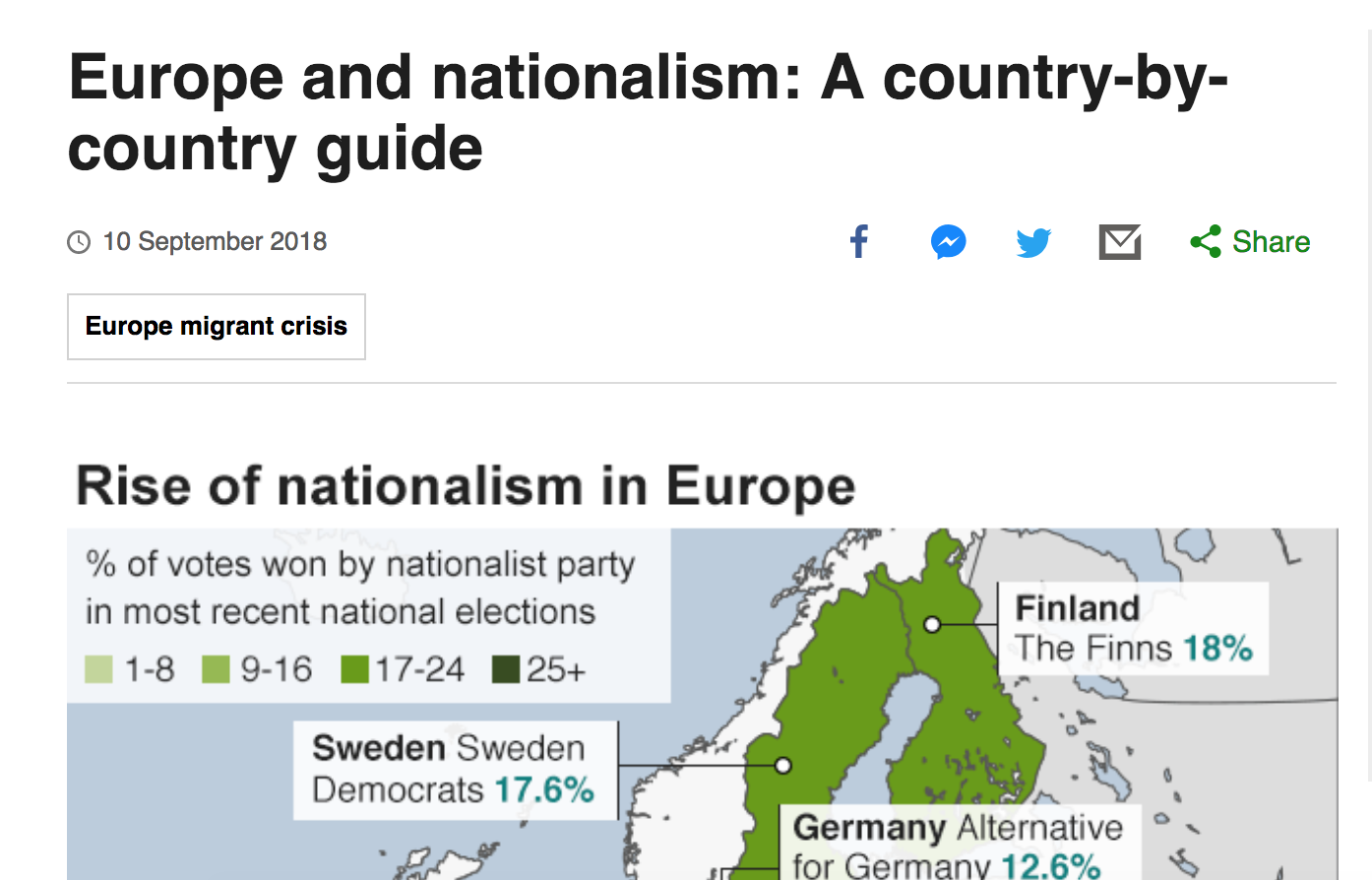
https://www.bbc.com/news/world-europe-36130006
I agree with Frum’s thesis. We see more countries elected anti-immigration leaders. This is because people fear ambiguity. Until we have more policies directed towards integration, immigration will remain ambiguous. Hence, there needs to be finite policies in place that outline numbers of immigrants, reasons for immigration, and systems for integration. However, this funnels directly back into Frum’s article. There is no proper discourse in today’s political environment. This creates a vicious cycle immigration policy never changes, the two parties refuse to make concessions, and the two sides become more radical. This is made more challenging because immigration is human issue, one that is complex in cause and function.
Sources:
“Europe and Nationalism: A Country-by-Country Guide.” BBC News, BBC, 10 Sept. 2018, http://www.bbc.com/news/world-europe-36130006.
Galer, Sophia Smith. “Culture – The Aladdin Controversy Disney Can’t Escape.” BBC, BBC, 14 July 2017, http://www.bbc.com/culture/story/20170714-the-aladdin-controversy-disney-cant-escape.
Frum, David. “If Liberals Won’t Enforce Borders, Fascists Will.” The Atlantic, Atlantic Media Company, 11 Mar. 2019, http://www.theatlantic.com/magazine/archive/2019/04/david-frum-how-much-immigration-is-too-much/583252/.
Funk, Nathan C. and Said, Abdul Aziz. Islam and the West: Narratives of Conflict and Conflict Transformation. International Journal of Peace Studies, Volume 9, Number 1, Spring/Summer 2004

