by Jacob Feist
Part a: The foundation of the current fundamentalist jihadi movement
The jihadi movement stems the word and ideology of Jihad. It refers to the idea that one should fight within oneself to prevent sin and promote purity. However, it also pertains to the protection and proliferation of Islam. These definitions are specific enough to create cause, but vague enough to leave interpretation. Thus, you have many different extensions of Jihad. Many view it as a method to abide by the laws of the Quran. These interpretations usually stem from Muhammad’s proclamation upon his return from war. After defending the Muslim community through war, he returned home and explained that he must now focus on the “greater Jihad”. This being a reference to the internal struggle over studying, overcoming anger, and being an active and productive member of a Muslim community.
However, a more sinister interpretation has also been derived from the text. One that emphasizes the definition of Holy War. This sector believes that violence against those that would oppose Islam is the true calling of Jihad. As conflict and tension rose in the Middle East, these groups grew in number and influence. Eventually, they adopted aggressive recruiting techniques focused on susceptible at-risk youth. These groups then educate and radicalize new members into committing violent acts against those who do not obey Jihad. One of the most harrowing and vivid depictions of this process is told by Manwar Ali. He explains the historic background, the methods employed by the fundamentalist jihadi, and the impact it has on himself and the international community.
Part b & c: Sharia Law, Fundamentalists, & Punishment
Sharia law is a set of laws outlined by the Quran designed to help guide Muslims. The text specifically refers to lifestyle choices, daily prayers, times of fasting, and acts of charity. Moreover, it is an interpretable process that categorizes actions into those that are encouraged, discouraged, and forbidden. The primary focus is the extension and longevity of the religion. Thus, it tends to focus on abiding by the text and marriage. However, there are also legal principles. In U.S. law these principles would be parallel to criminal law. They are guidelines for addressing the harshest crimes that disrupt civility. These are categorized by laws punishable by the words of the text and punishments dictated by the judgment of a tribunal.
This is where the division in interpretation tends to materialize. Unfortunately, fundamentalists have also skewed and misrepresented the value of Sharia law, placing greater emphasis on the system of punishment than necessary. They promote archaic punishments and treatments of others. These stories typically create more headlines than those who use Sharia law to simply live a peaceful life and as a result have created a negative impression of Sharia law on the global community.
Thus, an impression has been created that Islamic law is consumed by punishment. Unfortunately, there are incidents that tragically reinforce this stereotype. The United Nations has had to condemn punishments of lashings and stoning in certain communities, but that does not reflect on the beliefs on an entire people. Personally, I find the notion of an over-emphasis on punishment strange because foundationally every legal system has to have a system of punishments. Moreover, while I agree that certain aspects of the punishments may be overly harsh, simply criticizing the concept of a punishment focused legal system seems peculiar.
Part d: Musawah
Musawah is an organization designed to promote equality and justice within the Muslim community. The organization is comprised of Muslim leaders, both male and female on their joint mission. The primary focus of this objective being the use of Islamic holy texts and values to combat injustices against women and promote equality. Additionally, they assist in human rights campaigns in Muslim countries. The organization achieves these goals through advocacy programs, education programs, and community building.
Musawah outlines this cause into four distinct categories:
- Equality
- Non-Discrimination
- Justice
- Dignity
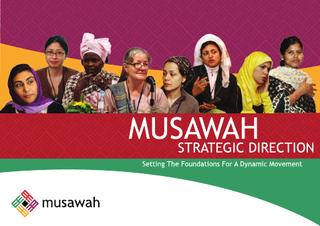
My assessment of this organization is that it is the exact program one would search for in combating the negative stereotypes associated with Islam. This program highlights the positive values of Islam and Sharia law. Moreover, it operates internally through advocacy programs and externally through education programs. I also applaud their mission towards creating inclusive communities focused on dialogue and community action.
Sources:
http://www.bbc.co.uk/religion/religions/islam/beliefs/jihad_1.shtml
https://www.bbc.com/news/world-27307249
http://www.bbc.co.uk/religion/religions/islam/beliefs/sharia_1.shtml

