by Jacob Feist
Part 1a: The Cheetah of Tanzania
In Post 3, I discussed Steven Radelet’s definition of the Cheetah Generation. This generation continues to make incredible social and political progress in Africa. However, progress in this grand scope is often hard to fully appreciate. Thus, I am highlighting the efforts and accomplishments of one member of the Cheetah Generation in Tanzania.
Rebeca Gyumi grew up in Tanzania and at a young age began to recognize the suffering imposed upon women. At 13, she witnessed children her age subjected to forced marriages due to unwanted pregnancies. This upsetting concept motivated her to join a youth initiative at the age of 20 to combat this problem. As she continued to work with this organization, she recognized the magnitude of this national problem. A staggering 37% of women were being forced into marriage before the age of 18 in Tanzania. Hence, she went to school at University of Dar es Salaam and received a degree in Law. She used her education and experience to create a political campaign and legal petition to raise the legal age of marriage.
In 2016, she accomplished her goal and The Marriage Act of Tanzania was altered. However, this was not the end of her struggle. Like many Cheetahs, she upset the status-quo and received harsh backlash from members of the Hippo Generation. The government appealed the ruling to the high court of Tanzania and continues to fight the ruling. In spite of all this, Gyumi stills lobbies on behalf of women’s rights and the changes to The Marriage Act. As a result, she was rewarded the 2018 UN Human Rights Prize.
Part 1b: Democracy in Tanzania
In Emerging Africa, Steven Radelet works to define democracy and the impact it has on society. His definition revolves around five key concepts that when present create a stable democracy.
- Protecting fundamental political freedoms
- Protecting civil liberties
- Free and fair elections
- Representative government
- Checks on executive power
Currently, sources use similar definitions to grade a countries democracy or democratic progress. According to Freedomhouse, Tanzania classifies as “partly free” with a composite score of 60/100. The report indicates that the country is moderately free in both political and civil rights.
A more detailed report indicated the following:
| Topic | Score |
| Electoral process | 8 out of 12 |
| Political pluralism | 12 out of 16 |
| Functioning government | 7 out of 12 |
| Freedom of expression | 9 out of 16 |
| Organizational Rights | 6 out of 12 |
| Rule of law | 9 out of 16 |
| Individual rights | 9 out of 16 |
| https://freedomhouse.org/report/freedom-world/2016/tanzania |
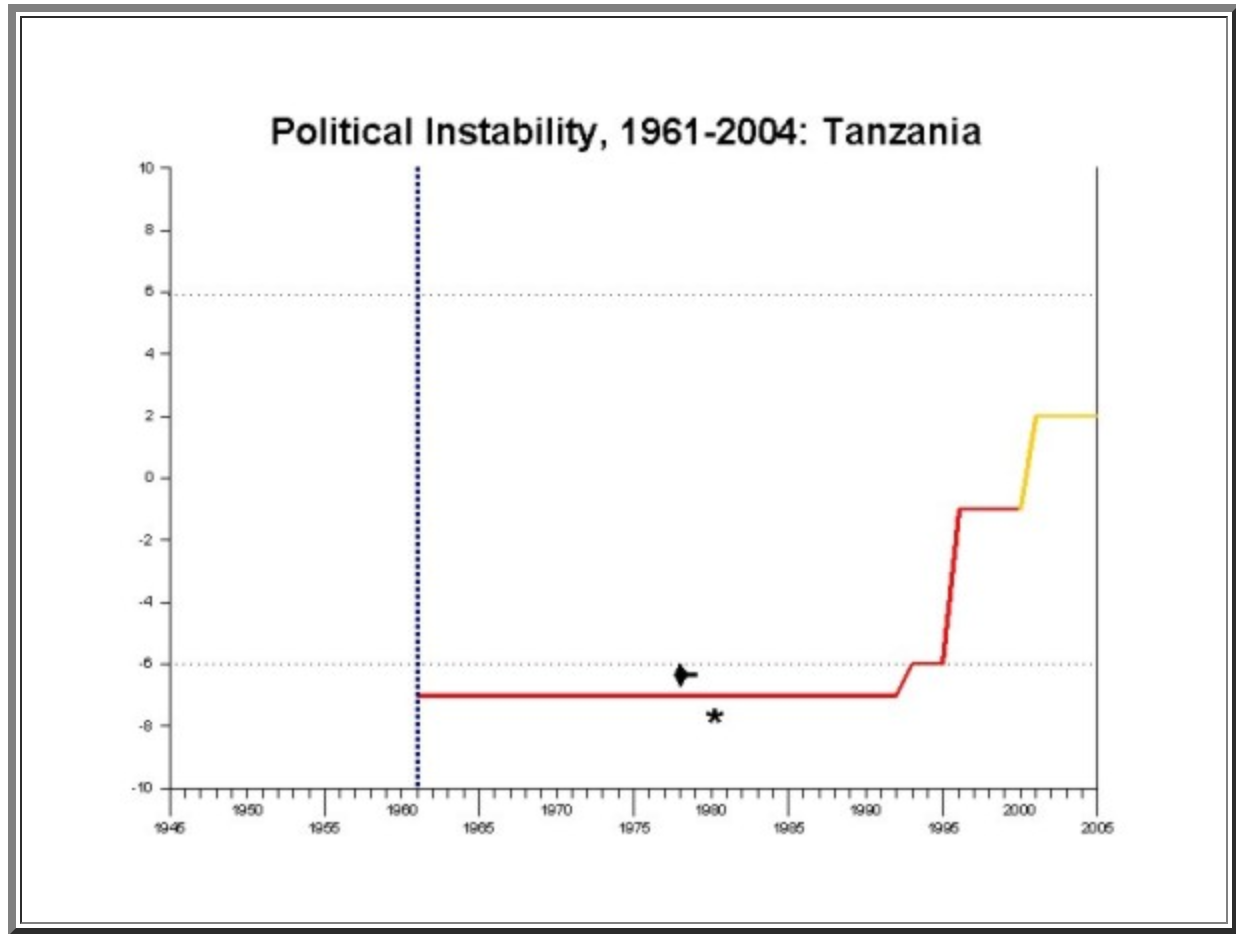
This is also reflected in the Political Instability Chart on Systematicpeace, which showed their political stability rising over the 44-year sample size. However, the country still has much to accomplish. In the local news, current events discuss President John Magufuli’s persistence on fighting women’s rights initiatives. In December, he made a decree insisting young mothers should not be allowed to rejoin the public-school system. This law would prevent 35% of married women from receiving an education. Fortunately, young leaders still have access to create progress through role-models like Rebecca Gyumi or the YALI network.
Part 2: Effective Health Investments
In Chapter 3 of “Poor Economics”, Banerjee and Duflo argue the economic benefits of effective health investments. Their position is rooted in the idea that the many prevalent poverty traps tend to stem from an ailment in the family or widespread health epidemics. This is supported by the evidence that countries with malaria outbreaks tend to have weaker economies than those without. While there are other determining factors, one can see the connection. A workforce plagued by disease will invariably be less productive, bringing down the overall efficiency of the market.
Hence, a relatively simple solution to strengthen a countries economy would be to invest in effective health investments. These investments are healthcare products that creating lasting economic returns for the user. One prime display is malaria nets in Kenya. Using data captured by the authors, we can see the return on investment for an individual in Kenya. (Table 1, data on page 45)
| Table 1 | No Investment in Malaria net | Investment in Malaria net |
| Malaria net | $0 | $14 |
| Effectiveness of malaria net | 0% | 30% |
| Annual income | Individual with malaria: $295 | Healthy individual: $590 |
| Potential return on investment | 0 | +$295 |
| Expected return on investment | 0 | 295*.30 = $88.5 |
Other examples of effective health investments include water sanitation and piping. Banerjee and Duflo explain that these two investments usually reduce infant mortality by 75% and overall mortality by 50%. They also limit the spread of disease and common illnesses. Consequentially, a country would have an increased workforce in both population and effectiveness.
However, effective health investments are not easy to implement. Primarily, people in poor, developing, nations tend to not spend money on preventative care. Even in cases that the items are inexpensive and readily available, only 10% of the population actually purchase the item. Furthermore, an increase in income creates minimal increases in demand, meaning that the only real impact is price reductions. This is amplified by a distrust for doctors and the public healthcare system. Unfortunately, this distrust is often justified, as public health centers have scored remarkably poor on both tests of reliability and consumer support. There is also a critical lack of education related to healthcare, biology, and medicine. Thus, people opt for alternative solutions or refuse to take medicines they deem ineffective.
Sources:

