By Jacob Feist
Part a: An overview of Muslim Youth in Europe
Struggles and Identity in Europe
In the book, “Islam, Europe’s Second Religion”, Peter Mandeville outlines the complicated and precarious topic of Muslim Youth in Europe. Mandeville explains that there must be a distinction in explaining the plight, progress, and outlook for Muslim youth because their experience will invariably be different than their parents. Many of the youth are second or third generation and consider themselves integrated part of European society. Thus, when topics of Muslim discrimination arise, there is a duality forced upon them between their European home and their religion. This struggle is amplified by those Muslim youth that have prioritized and focused on their religion. This youth group uses their religion has self-identification, but also in forms of social action.
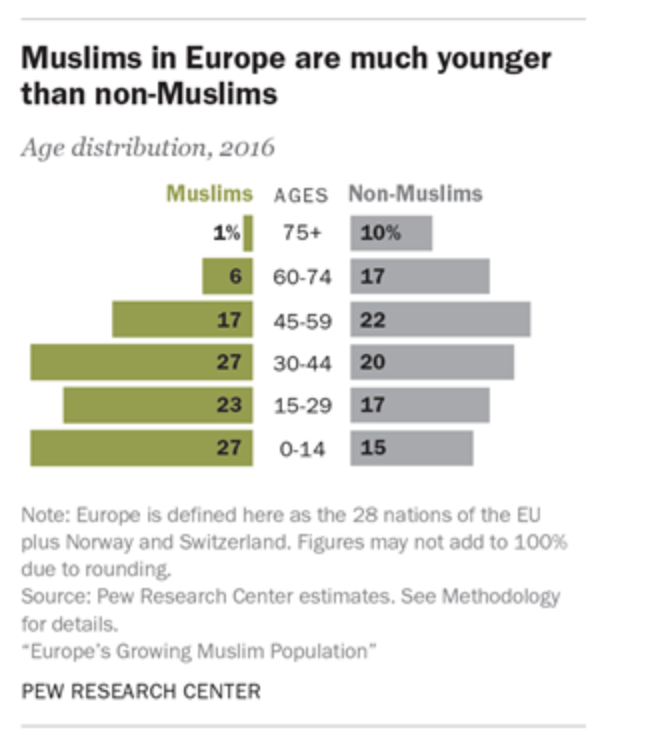
What role does discrimination play in the formation of Muslim youth identities?
The duality mentioned above is an enormous burden for any young person. Thus, many young Muslims feel that Europe has not been an easy place to call home. There is the constant imagery issues mentioned in the post 11, proliferating stereotypes and creating barriers. Moreover, there is the constant pressure for youth to conform to their society, which is a harsh reality for young Muslims. Thus, many Muslim youth struggle with this conflict. They view assimilation as cultural abandonment and religion as conflict with Europe.
Making this decision more difficult is the idea that assimilation into to European culture may not be possible, or invited, with all groups. There are undoubtedly issues with islamophobia and discrimination in Europe. This presents the idea that potentially assimilating is betrayal. Moreover, it makes the idea of assimilation seem unwelcomed. It is tragic that these ideas and decisions are thrust onto Muslim youth. Rather than being able to naturally form their own religious identity, they are forced to create an identity based on conflict, discrimination, and cultural dualities.
Part b: Assimilation, Communitarianism, or New modes of integration
In the concluding portion of, “Islam, Europe’s Second Religion”, the modes of integration are outlined. Shireen Hunter explains that those in favor of assimilation focus on European culture. They feel that Muslim citizens should focus on their citizenship and blend into society. They should not allow their religion to create conflict, it should remain a household focus. Communitarianism believes in a blend of religion and culture. A society in which the two interact, acknowledge each other, and act in a harmony. Those that prefer a more European focus can do so, those that prefer a religious lifestyle may also peruse those goals. The key is that these groups engage and discuss with themselves and external parties.
There is no correct method, preferred method, or perfect method. Yet, this will inevitably be a decision for most Muslim youth in Europe. It appears ever more likely that even those that choose assimilation will be brought into communitarianism. This is because Muslim is a reality of European life and a part of Europe’s future. It will be a topic discussed in politics, households, and schools. The conversations will occur and eventually Muslim youth will be forced to be part of that conversation.
Part c: Malik’s “Diversity Myth”
Kenan Malik explains that the Diversity Myth is a concept that has existed within Europe for centuries. It is the idea that despite public efforts towards integration and multiculturalism there has always been perceptual differences towards immigrants. This is because multiculturalism focuses on the integration and blending of cultures. Yet, this requires sacrifices and acceptance from the native group, which typically breeds resentment. Thus, extending from Victorian France until today, native groups that have the same values, interests, and socio-economic status, as immigrants will still view immigrants as the “other”. Rather, native groups prefer assimilation, where a culture joins the native population and sacrifices its own culture.
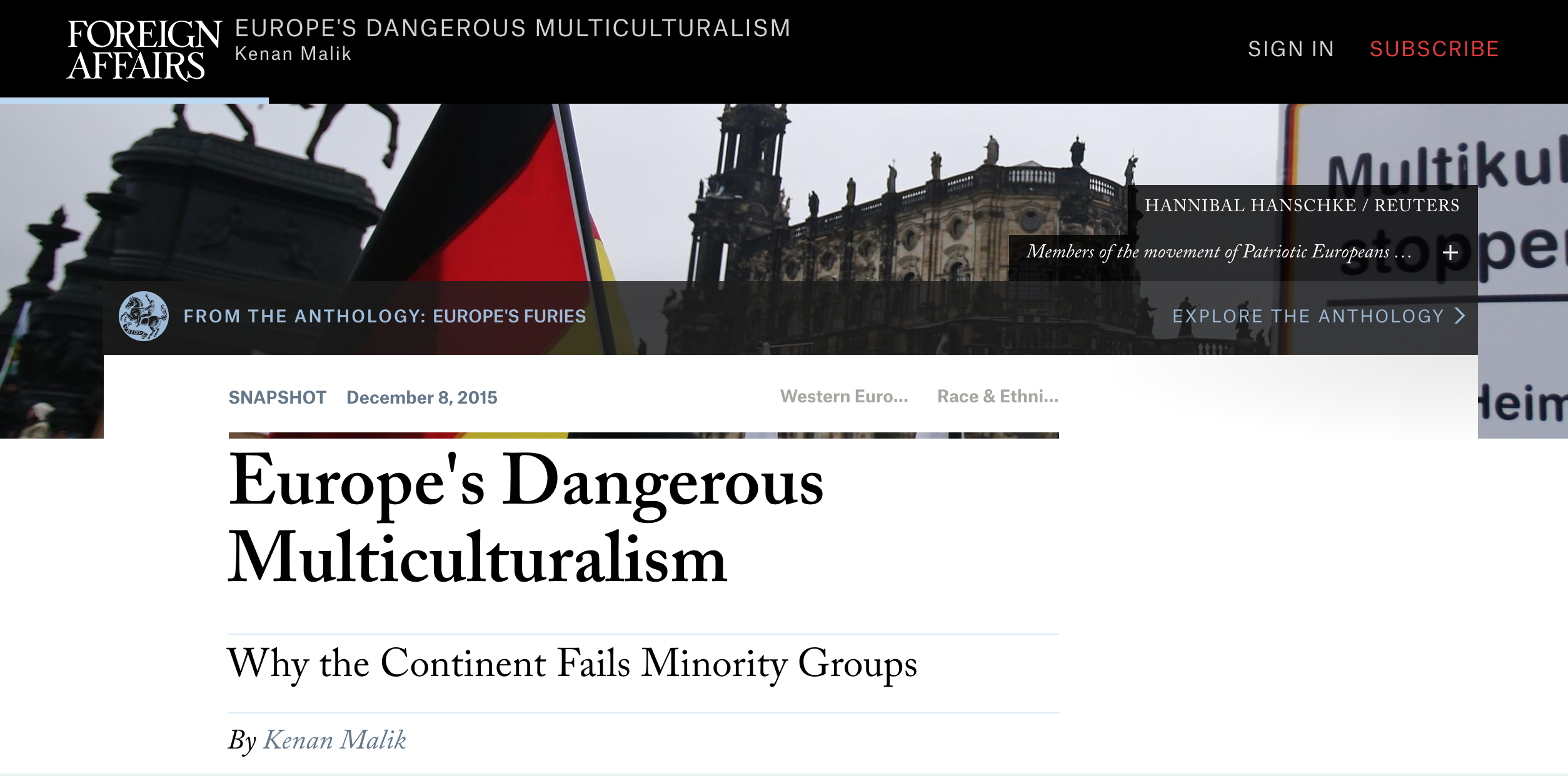
Kenan Malik’s follow-up article in his “Europe’s Furies” anthology
Part d: Sajan
In Jainism, there is a concept, “Anger begets more anger”. It is the idea that hate breeds hate, resentment creates frustration, and any conflict only serves to create more conflict. It is not a revolutionary concept, but it is one worth noting as it is ever-relevant and often forgotten. Moreover, it is an idea very relevant to Sajan’s article, which outlines the origin of Europe’s homegrown terrorism. She explains that the countries that experienced an influx of Muslim immigrants are now dealing with the ramifications of racism, ostracism, and lack of integration. She explains that those marginalized by society have lost their identity and found solace in hatred. It is a tragic truth that by no means justifies the actions of those that commit crimes of terrorism, but highlights the dire need for integration and empathy in these trying times.
Sources:
Malik, Kenan. “The Failure of Multiculturalism.” Foreign Affairs, Foreign Affairs Magazine, 19 Feb. 2019, http://www.foreignaffairs.com/articles/western-europe/2019-02-18/failure-multiculturalism.
Sajan, Thomas, and Titto Idicula. “Decoding Europe’s Homegrown Terror.” @Businessline, The Hindu BusinessLine, 12 Jan. 2018, http://www.thehindubusinessline.com/opinion/decoding-europes-homegrown-terror/article9718569.ece.
“12 & Conclusion.” Islam, Europe’s Second Religion: the New Social, Cultural, and Political Landscape: by Shireen T. Hunter, Praeger, 2002.

